
C.S. Lewis on How Aliens Impact Christianity
The Oxford Don, the Alien and the Way Forward
This is the last week to get 20% off an annual paid subscription. Don’t miss our read-along of The Magician’s Nephew.
Also, get ready for the 2026 Narnia Madness tournament. The bracket will be revealed next week, with voting starting immediately.
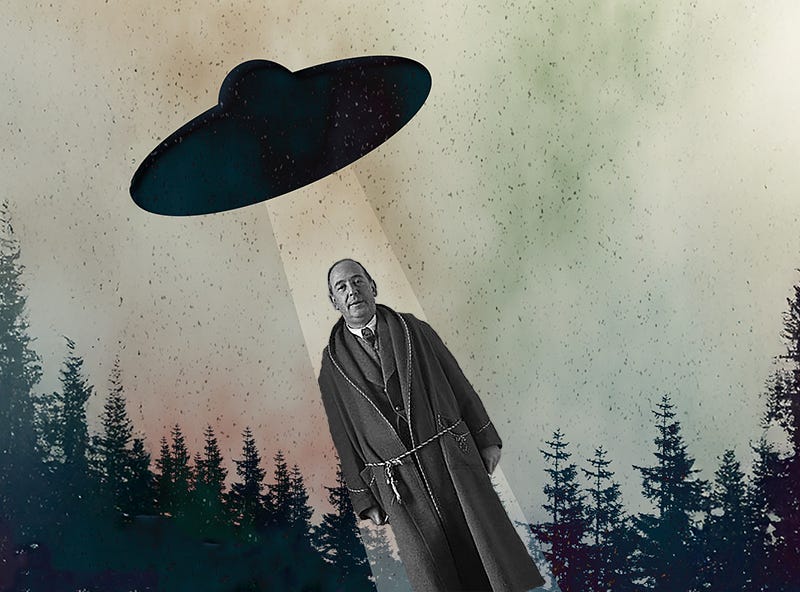
Recent comments by former President Barack Obama and President Donald Trump sparked renewed interest in aliens and what the U.S. government knows about intelligent life in the universe.
During a Feb. 14 podcast interview, Obama said aliens are “real.” But then added, “They’re not being kept at Area 51. There’s no underground facility—unless there’s this enormous conspiracy and they hid it from the President of the United States.”
A few days later, Trump announced he was instructing federal agencies to begin releasing government files.
“I will be directing the Secretary of War, and other relevant departments and agencies, to begin the process of identifying and releasing government files related to alien and extraterrestrial life, unidentified aerial phenomena (UAP), and unidentified flying objects (UFOs), and any and all other information connected to these highly complex, but extremely interesting and important, matters.”
Most know C.S. Lewis wrote a science fiction trilogy about travel to other planets home to alien lifeforms, but he also spoke about the issue from a philosophical and theological angle.
One of the central truths that Lewis made clear—in both his fiction and nonfiction writing on the subject—was that humanity could not assume any moral supremacy over life from other planets.
He explained this more during a presentation to Anglican leaders in 1945, reprinted as “Christian Apologetics” in God in the Dock.
“If Earth has been specially sought by God (which we don’t know), that may not imply that it is the most important thing in the universe,” he said, “but only that it has strayed.”
In 1958, a year after the U.S.S.R. sent Sputnik 1 into orbit around the Earth , Lewis argued that the discovery of life on other planets wouldn’t challenge Christian theology very much.
Each new discovery, even every new theory, is held at first to have the most wide-reaching theological and philosophical consequences. It is seized by unbelievers as the basis for a new attack on Christianity; it is often, and more embarrassingly, seized by injudicious believers as the basis for a new defense.
But usually, when the popular hubbub has subsided and the novelty has been chewed over by real theologians, real scientists and real philosophers, both sides find themselves pretty much where they were before. So it was with Copernican astronomy, with Darwinism, with Biblical Criticism, with the new psychology. So, I cannot help expecting, it will be with the discovery of “life on other planets” – if that discovery is ever made.
In the essay, later retitled “Religion and Rocketry” and reprinted in The World’s Last Night and Other Essays, Lewis argued extraterrestrials could, however, raise questions about the Incarnation.
If there is intelligent life on many other planets, does it make sense that God became human to redeem the world?
He then asks five progressive questions dealing with the spiritual nature of such animals, should that discovery ever take place. The questions are designed to see how alike us, spiritually speaking, alien life is, for better or worse.
Is there animal life somewhere other than Earth?
Do these creatures possess a rational soul?
Are aliens, like humanity, fallen?
If they are fallen, did Christ die for them?
Is the mode of redemption we know the only possible way for Christ to redeem them?
Those will be the questions that need to be asked and answered should we ever find life beyond Earth, but Lewis argued that Christianity will always be plausible no matter our scientific discoveries.
Christians and their opponents again and again expect that some new discovery will either turn matters of faith into matters of knowledge or else reduce them to patent absurdities. But it has never happened.
What we believe always remains intellectually possible; it never becomes intellectually compulsive. I have an idea that when this ceases to be so, the world will be ending. We have been warned that all but conclusive evidence against Christianity, evidence that would deceive (if it were possible) even the elect, will appear with Antichrist.
And after that, there will be wholly conclusive evidence on the other side.
But not, I fancy, till then on either side.
For more, see the essay I wrote for Christianity Today: “C.S. Lewis Warned Us About Close Encounters of the Evangelical Kind.”
More from The Wardrobe Door
Archive
Escaping the “Universe of Pure Hatred”
The social internet and social media, in particular, have a perversive impact on human interaction. Obviously, the proliferation of pornography on the platforms degrades how we view others, but social media itself has perverted the incentives of social interactions between normal, fully clothed people.
Recent
Elsewhere
Christian Persecution Reaches Extreme Levels in Several Nations — Lifeway Research
Religiously Unaffiliated Americans Not Completely Irreligious — Lifeway Research


