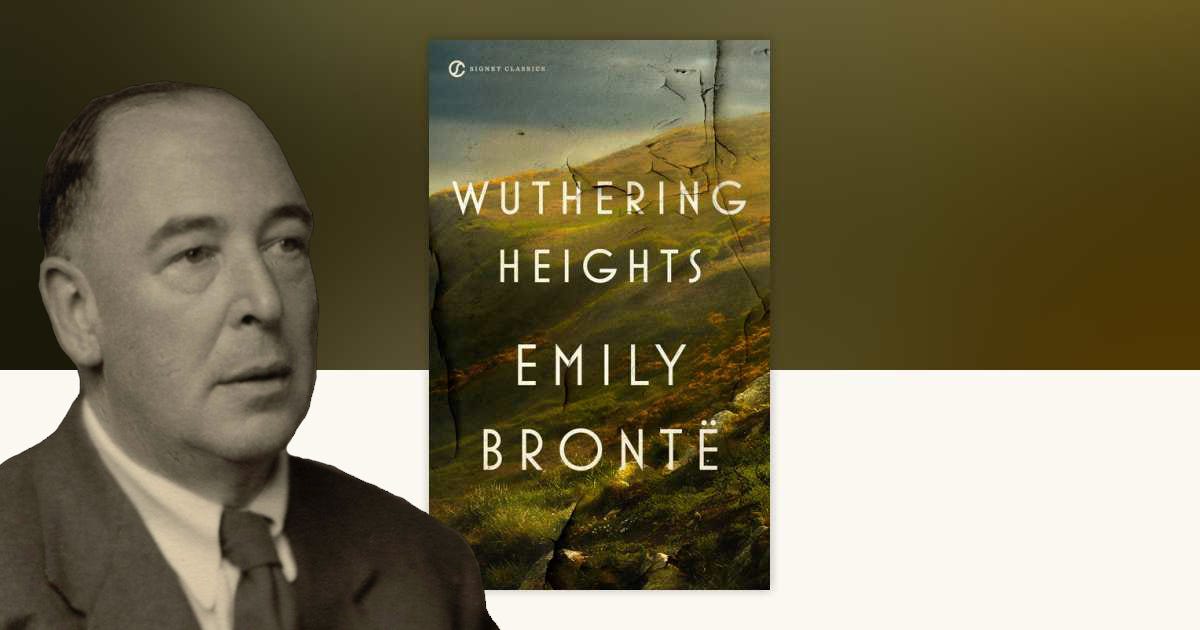
C.S. Lewis on “Wuthering Heights”
His surprising thoughts on Emily Brontë’s classic
Greta Gerwig’s Narnia film is not the only highly anticipated book adaptation releasing this year.
In addition to cinematic versions of The Odyssey and Dune Messiah coming later, Emerald Fennell recently released her version of Emily Brontë’s classic Wuthering Heights.
I have not seen the film, nor do I plan to, based on what I’ve read. One viral Letterboxd review said: “Emily Brontë died of tuberculosis 177 years ago, yet this adaptation is still the worst thing that has ever happened to her.”
While I tend to doubt C.S. Lewis would enjoy Fennell’s adaptation, he did read and appreciate Brontë’s original, which may come as a surprise to some.
In his letters, he frequently mentions both Emily and her sister Charlotte’s work.1
When he was 13, he mentions having read Emily’s book for the first time, though he confuses her with her sister.
“Last week I got out of the library the works of our present poet laureate, Bridges, who did not impress me a bit; but I have now struck better ground in Charlotte [sic] Bronte’s ‘Wuthering Heights,’ which although melodramatic like all her books, shapes very well indeed.”
The next year, writing to his childhood best friend, Arthur Greeves, he said the writing of the Brontë sisters “should be sipped with luxurious slowness in the winter evening.”2
Throughout his life, Lewis would continue to use Wuthering Heights and the Brontës as a positive comparison for novels he enjoyed, characters he was writing, and atmospheres he experienced.
As he began his academic career, Lewis returned to the book.3 On Christmas 1931, he told his brother that he just reread it. “I should not like to make it my constant fare, but I still like it very much,” he wrote.
The next month, he told Greeves about his rereading:
“I thought it was very great. Isn’t it (despite the improbability) an excellent stroke of art to tell it all through the mouth of a very homely, prosaic old servant, whose sanity and mother-wit thus provides a cooling medium through which the wild, horrible story becomes tolerable?”
It was another teenage letter with Greeves, however, that may give us our greatest insight into the lasting impact of the Brontës on his life and writing.
In 1915, Lewis and Greeves had a melodramatic teenage correspondence about whether or not they had ever been in love. Lewis is confident in his opinions about the subject because of his reading:
“But though I have no personal experience of the thing they call love, I have what is better—the experience of Sapho, of Euripides of Catullus, of Shakespeare, of Spencer, of Austen, of Bronte, of anyone else I have read. We see through their eyes. And as the greater includes the less, the passion of a great mind includes all the qualities of the passion of a small one.”
In some ways, this sounds like a typical teenager: possibly wrong but never in doubt. But yet, this is a position Lewis held onto for the rest of his life, at least in terms of the perspective gained from reading.
In An Experiment in Criticism, he used the same illustration of seeing through others’ eyes.
The man who is contented to be only himself, and therefore less a self, is in prison. My own eyes are not enough for me, I will see through those of others. Reality, even seen through the eyes of many, is not enough. I will see what others have invented. ... In reading great literature, I become a thousand men and yet remain myself.
Lewis always regarded reading as a way to gain knowledge and expand our perspectives. He learned that in part through his surprising appreciation of Wuthering Heights.
Still, his embrace of Christianity later in life and his own romance with Joy Davidman would encourage him to go further.
In “Meditations in a Toolshed,” reprinted in God in the Dock, he challenges the notion that external investigation of a subject is the only valid source of knowledge. Personal experience is also a way to gain true knowledge.
We must, on pain of idiocy, deny from the very outset the idea that looking at is, by its own nature, intrinsically truer or better than looking along. One must look both along and at everything… we must start with no prejudice for or against either kind of looking. We do not know in advance whether the lover or the psychologist is giving the more correct account of love, or whether both accounts are equally correct in different ways, or whether both are equally wrong. We just have to find out.
Reading Wuthering Heights challenged Lewis and expanded his vision in and of itself, but it also encouraged him to go deeper. He learned about love from Brontë, but he didn’t really yet know love—either with another person or as the divine Tri-person.
As always, Lewis would tell us to go further up and further in.
Sources:
The Collected Letters of C.S. Lewis, Volume 1: Family Letters, 1905-1931
The Collected Letters of C.S. Lewis, Volume 2: Books, Broadcasts, and the War, 1931-1949
The Collected Letters of C.S. Lewis, Volume 3: Narnia, Cambridge, and Joy, 1950-1963
For more on the Lewis’ writing and his influences, don’t miss our new read-along of The Magician’s Nephew. The chapter-by-chapter breakdown for paid subscribers continues this Friday.
More from The Wardrobe Door
Archive
Recent
Elsewhere
Most Churchgoers Regularly Confess Sin — Lifeway Research
Charlotte wrote Jane Eyre, Shirley, Villette, The Professor, and more. Lewis also loved Jane Austen and, as we’ve discussed in our Narnia read-alongs, Edith Nesbit’s books served as a significant inspiration.
He did not enjoy the Brontë sisters’ poetry, however, and made several comments about it. Writing to Greeves in 1930 about how he enjoyed Precious Bane by Mary Webb “more than any novel since the Brontës’,” he asked, “Why do women write such good novels? Men’s novels, except Scott, seem to me on the same level as women’s poetry.”
In “On Criticism,” an essay republished in Of Other Worlds: Essays and Stories, Lewis discussed the difference between the “intention” and “meaning” of a book. “It is the author who intends; the book means.” He gives some examples of texts that have obvious meanings, but even those often mean even more. Then, as an example of those that aren’t so obvious, he lists Twelfth Night, Wuthering Heights, and The Brothers Karamazov.