


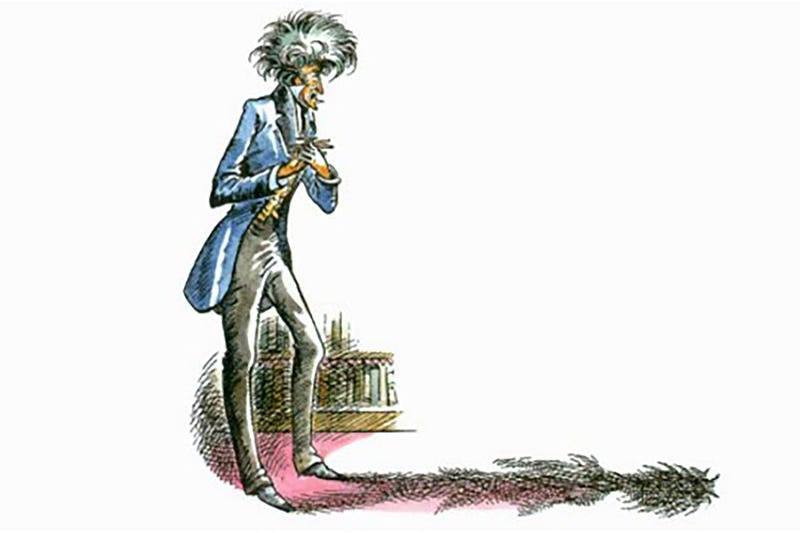
C.S. Lewis gives us iconic and interesting villains, but he does that without making them somehow praiseworthy or morally complicated. Readers may appreciate Uncle Andrew as a fictional character, but no one admires the character of his person.
No, Digory. Men like me, who possess hidden wisdom, are freed from common pleasures. Ours, my boy, is a high and lonely destiny.
Chapter 2 “Digory and His Uncle”
Not only has Uncle Andrew caused Polly to disappear in the previous chapter, but he warns Digory not to scream again because the boy’s sick mother may hear it and “you know what a fright might do to her.”
But it’s not just that; it’s the immediate reveal of Andrew’s hypocrisy. He had yelled when a guinea pig disappeared. This, as we will see in this chapter, is who Uncle Andrew is.
He demands a certain level of behavior and morality from those around him, but refuses to hold himself to the same standard. He is a type of Lewis’ ultimate villain—the Materialist Magician.
In The Screwtape Letters, the senior tempter reveals:
We are really faced with a cruel dilemma. When the humans disbelieve in our existence we lose all the pleasing results of direct terrorism and we make no magicians. On the other hand, when they believe in us, we cannot make them materialists and skeptics. At least, not yet. … If once we can produce our perfect work—the Materialist Magician, the man, not using, but veritably worshipping, what he vaguely calls “Forces” while denying the existence of “spirits”—then the end of the war will be in sight.
Throughout this chapter, Andrew shows himself to be this person and closely mirrors other Lewis’ villains, like Weston from the Ransom Trilogy, Jadis later in this book, Nikabrik in Prince Caspian, or Shift the ape in The Last Battle. I want to highlight Uncle Andrew’s characteristics to help us recognize similar real-life bad guys.
First, however, Andrew gives us his backstory (or villain origin story if you’d prefer). He said his godmother, Mrs. Lefay, had been in prison but refused to elaborate on what she had done.1 Before she died, Mrs. Lefay gave the young Andrew a secret box and told him that he must destroy it as soon as she died.
He, of course, didn’t do that, but was careful with the box. He knew it must contain something powerful because of who she was—“one of the last mortals in this country who had fairy blood in her.”2
Investigating the box, he discovered it was Atlantean. Then, using nefarious means that seemingly harmed himself (both physically and spiritually), Uncle Andrew was able to open the box and find it contained dust “that had been brought from another world when our world was only just beginning.”
Working through experiments that led to numerous guinea pigs suffering violent deaths, Uncle Andrew fashioned the dust into rings. He created yellow rings that draw you out of this world and into the “Other World,” and eventually green rings that he hopes will bring you back to this world.
Digory realized that Uncle Andrew had manipulated the entire situation: tricking Polly into specifically taking a yellow ring, leaving her with no green ring and no way home, unless Digory went after her with his own yellow and two green rings.
Nothing about the situation is right or fair, but Digory agrees to take the rings and follow after Polly. “And he thought then, as he always thought afterward too, that he could not decently have done anything else.” That is the difference between him and Uncle Andrew.
Now, let’s look through Andrew’s arguments to see characteristics of the Materialist Magician that Lewis wants to warn his readers about.
