

The Little-Known Way C.S. Lewis Fought for J.R.R. Tolkien’s Literary Legacy
Files released after 50 years reveal Lewis’ devotion to his friend’s work

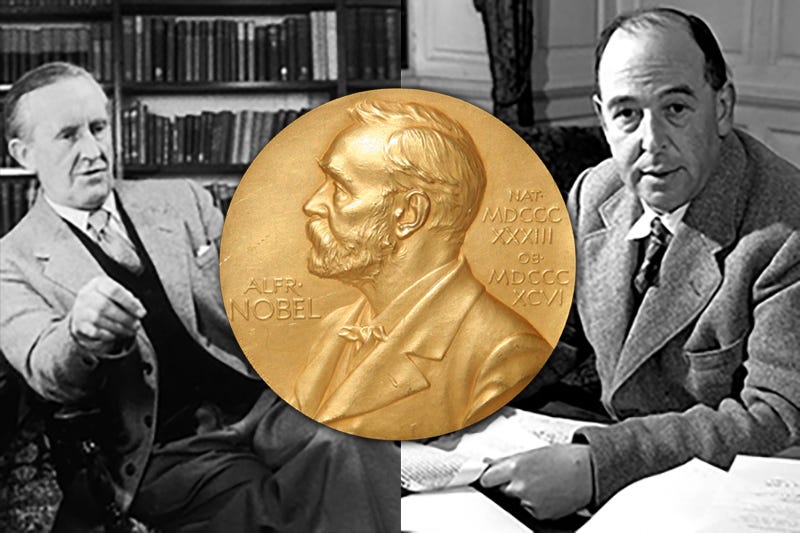
The Lord of the Rings often tops literary lists, both best-selling and most beloved. One award J.R.R. Tolkien never achieved, however, was the Nobel Prize in Literature. But that wasn’t due to the lack of a passionate nomination.
Both the identity of Tolkien’s nominator and the fact of his 1961 nomination were unknown to the public—and likely to Tolkien himself—until 2012, when the Nobel Committee released the files.
Tolkien’s friend and fellow Inkling, C.S. Lewis, had been the first person to nominate him for The Lord of the Rings.
The Nobel Committee invited C.S. Lewis, as chair of the literature department at Cambridge, to offer a nomination for the award.
On Jan. 7, 1961, Lewis wrote to Alastair Fowler, a literary scholar and former student, and asked, “in confidence,” who he thought should be nominated for the Nobel Prize in literature. Lewis offered some options: “Frost? Eliot? Tolkien? E.M. Forster?”
It didn’t take long for Lewis to make up his mind. Nine days later, he wrote to the committee to say he had the honor of nominating Tolkien for his “celebrated romantic trilogy.”
Tolkien was one of 93 authors to be nominated for the 1961 prize, including Aldous Huxley, John Steinbeck, Graham Greene, Jean-Paul Sartre, Robert Frost, and eventual winner Yugoslavian writer Ivo Andrić.
Anders Österling, the lead literary critic for the Nobel Committee, said The Lord of the Rings “has not in any way measured up to storytelling of the highest quality.”
Fantasy literature of the kind Lewis and Tolkien wrote and enjoyed was not widely popular until they made it so, but it was particularly dismissed by literary critics. That explains why Lewis and Tolkien wrote so many essays defending fairy stories as literature.
Tolkien was nominated for the Nobel Prize two more times.1 The year following his nomination of Tolkien, Lewis nominated American poet Robert Frost.2
While Lewis was unsuccessful in his attempts to see Tolkien recognized by the Nobel Committee, he succeeded in the much greater task of helping Tolkien win recognition from the public.
In his review of The Lord of the Rings, Lewis wrote, “Nothing quite like it was ever done before.” It was so different and unpredictable, he compared it to “lightning from a clear sky.”
While the Nobel Prize would certainly have been deserved, no greater praise could be bestowed on a writer and his work than what Lewis said of Tolkien.
The book is too original and too opulent for any final judgment on a first reading. But we know at once that it has done things to us. We are not quite the same men. … I have little doubt that the book will soon take its place among the indispensables.
If you enjoyed learning more about Tolkien and Lewis, consider becoming a paid subscriber. We just talked about Lewis, Tolkien and the Nobel Prize in the paid section of Monday’s news post.
More from The Wardrobe Door
Coming soon
We’ll discuss Lewis’ strong opinion on hymns, but how it didn’t prevent him from attending and valuing his local church.
We’ll also look more at what Lewis said about The Lord of the Rings and how he already rebutted the most common modern objection to Tolkien’s writing.
Archive

Recent


Elsewhere
Spiritual Matters Missing From Many Churchgoers’ Conversations — Lifeway Research
In 1967 by Swedish professor and philologist Gösta Holm and in 1969 by British archaeologist and Greek professor Richard Ernest Wycherley
Frost never won despite being nominated 31 times from 1950-1963.
We expect far too much of our “experts.”
Has a writer of speculative fiction ever won a Nobel Prize? I'm sure that the committee members rolled their eyes and passed on to discuss a more "worthy, literary" work.