

The Magician’s Nephew: Chapter 1 “The Wrong Door”
C.S. Lewis Read-Along, Vol. 6, Issue 2

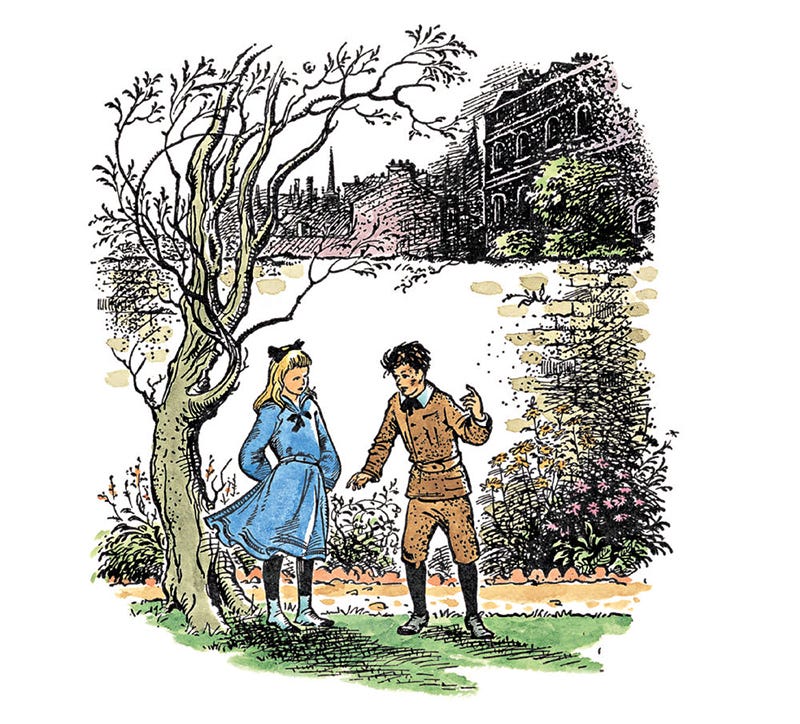
This is a story that starts with a male and a female in a garden. No, it’s not that Story, but it does reflect that story and reminds us of our need to overcome temptation and discover the right door that leads to redemption.
This is a story about something that happened long ago when your grandfather was a child. It is a very important story because it shows how all the comings and goings between our own world and the land of Narnia first began.
Chapter 1 “The Wrong Door”
Most of the time, our read-alongs jump straight into the chapter text, but it’s worth lingering for a moment on the chapter title—“The Wrong Door.”
In some sense, this is an obvious description of what happens to Digory and Polly as they explore the attic of their long row house. But it might also have a deeper meaning connected to Lewis’ famous sermon “The Weight of Glory.”
Speaking at Oxford University Church of St. Mary the Virgin on June 8, 1941, he said:
We do not want to merely see beauty, though, God knows, even that is bounty enough. We want something else which can hardly be put into words—to be united with the beauty we see, to pass into it, to receive it into ourselves, to bathe in it, to become part of it … [But] at present we are on the outside of the world, the wrong side of the door. We discern the freshness and purity of morning, but they do not make us fresh and pure. We cannot mingle with the splendors we see. But all the leaves of the New Testament are rustling with the rumor that it will not always be so. Some day, God willing, we shall get in. [Emphasis mine]
The Magician’s Nephew is about trying to get into the longed-for world by the wrong door, but discovering the one true door.1 There are many “wrong doors” and this book.2 The one into Uncle Andrew’s attic just happens to be the first.
And speaking of wrong doors, The Magician’s Nephew is the wrong door by which to enter Narnia. The right path is through the wardrobe with Lucy.3 This opening paragraph demonstrates that.
If this is the first book you pick up, you have no idea about any “comings and goings between our own world and the land of Narnia” because this is the first time you’ve ever heard of Narnia.
Lewis gives us a quick explanation of the book’s setting in 1900 London. While he wasn’t in London during this time, this was his childhood, so he dropped his ever-present complaint about the schools then. But, he also casts the pre-World War I period as idyllic, which is appropriate for the first place we find the characters.
The Genesis symbolism in The Magician’s Nephew begins on the first page. The boy and girl meet in a garden, but unfortunately, this is a garden after the fall. The boy explains to the girl how he has been exiled from his home with a garden. Even worse, death has entered the scene.
Specifically, Polly saw a grubby-faced Digory climb over the wall into the garden. Their first meeting could’ve gone better. He had obviously been crying, and after he introduced himself, she made fun of his name.
As we discussed in the introduction, Digory explaining his circumstances is deeply personal to Lewis. The author had a mother who became sick and died while he struggled with a distant father. The character has a sick mother on her deathbed with a father who is (literally) distant in India.
As he drew from his own story, Lewis embedded much of Digory Kirke’s story even in his name. The name Digory likely originated from the Old English word digrian, which means to wander or stray from a path, and a French word meaning strayed or lost. For its part, Kirke traces its roots to Old Norse kirkja, meaning church, and to the Greek goddess Circe, who is related to magic and rings and connected to our word “circle.”
