

What a Donkey Can Teach Us About AI
C.S. Lewis’ warns us to not offload our thinking to something “more clever.”

Sometimes I’m asked why I spend time reading The Chronicles of Narnia. There is an unstated assumption that adults shouldn’t spend time with children’s books. Yet, reading good children’s literature, like Narnia, serves us better than much of modern writing ostensibly for adults.
C.S. Lewis’ children works are beneficial to all ages, including adults, because when you read Lewis, you get all of Lewis. His friend Owen Barfield said that what Lewis thought about everything was secretly present in what he said about anything.
As such, adults will find new truths as they walk back through the wardrobe and encounter Narnia again because the insight into human nature and our spiritual needs is baked into all his writing. The Last Battle is a prime example.
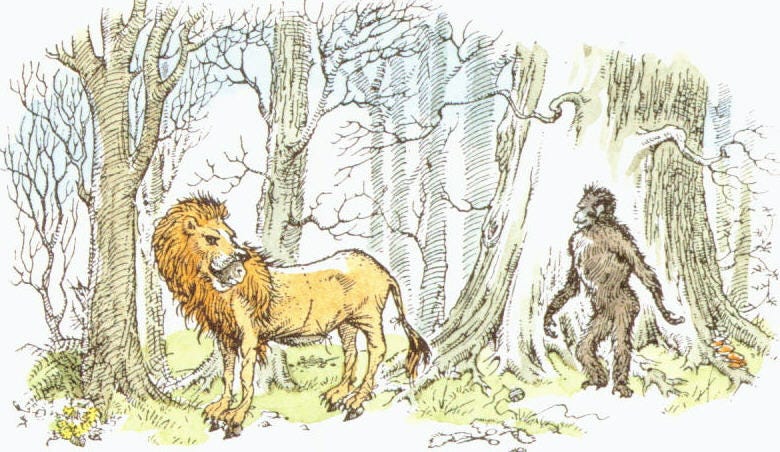
Reading through the final Narnia book in preparation for our upcoming read-along, I noticed more in the dynamic between Shift the Ape and Puzzle the Donkey. It paints a warning for us and our increasing reliance on technology, particularly AI.
On Friday, we start our read-along of The Last Battle. Don’t miss out on your opportunity to go further up and further in!
Become a paid subscriber to join our chapter-by-chapter discussion and gain full access to previous Narnia read-alongs in the archive.
Join now for 20% off for one year. That will take you through this read-along and into special coverage of Gerwig’s upcoming Narnia movie.
Shift has manipulated Puzzle throughout their lives, and now manipulates him into donning a lion skin and pretending to be Aslan. Obviously, the ape bears the greater share of the responsibility for all the evil that results, but Puzzle is not without blame.
Despite being constantly mistreated, Puzzle remains friends with Shift “because he knew that Shift was far cleverer than himself and he thought it was very kind of Shift to be friends with him at all.”
Puzzle falls victim to his own low expectations. He believes he isn’t clever, assumes he can’t do all the necessary thinking, and offloads it to Shift, who happily takes advantage of this situation.
Both have a wrong perspective of themselves. Shift, very clearly, thinks too highly of himself. But Puzzle thinks too poorly of himself. Both are primarily concerned with themselves and fail to view themselves as Aslan sees them.
Throughout the book, we can see Puzzle’s conscience prick him, but he acquiesces to Shift’s demands because the ape is “more clever.”
As humans, we dismiss our own cleverness and creativity, intelligence and ingenuity when we assume that we need AI to accomplish our work, particularly those mental exercises like reading and writing.
You and I may not be the cleverest people. We may even find AI to be “more clever” in certain instances. When we offload our thinking—or worse, our morality and our relationships—however, we miss out on much of what much of makes us human and we rob ourselves of opportunities to grow.
Later, Eustace challenges Puzzle after another one of his self-dismissive comments, “If you’d spent less time saying you weren’t clever and more time trying to be as clever as you could …” Unfortunately, Jill cuts him off before he can say more.
AI, like most technologies, can serve as a tool that encourages our humanity and enhances some capabilities. But too many treat AI as a shortcut through difficult moments—providing summaries for challenging books, offering “companionship” when we feel lonely, constructing written works for us.
Those efforts may save time, but they slowly make us less clever. We assume we aren’t able to do those tasks ourselves or we rob ourselves of working with other humans who could do them with us. Our thinking becomes so dependent on the AI that our lack of cleverness becomes a self-fulfilling prophecy.
But the solution is not to think differently about AI. The solution is to think correctly about ourselves.
The solution is not to think differently about AI. The solution is to think correctly about ourselves.
When Puzzle meets Aslan, the lion he impersonated, he gains the right perspective. Aslan whispers in the donkey’s ear something “at which his long ears went down; but then he said something else at which the ears perked up again.”
Aslan does not allow Puzzle to dismiss his role because he’s not clever. His ears go down because Aslan chastises him. But neither does Aslan force him to live in his mistake. Aslan gifts Puzzle a proper view of himself.
It should bring to mind Aslan’s words to Caspian when the young prince was disappointed that his ancestors were pirates from Earth. “You come of the Lord Adam and the Lady Eve. And that is both honor enough to erect the head of the poorest beggar, and shame enough to bow the shoulders of the greatest emperor on earth. Be content.”
We have, in our humanity, areas of weakness and strength. To fully realize our calling in this world, we need God’s provision and power.
We need His provision of other people to walk beside us. They can help us in areas of our lacking and moments of our need. We need His power to push us beyond all that we thought we could do ourselves. We can do all things through Christ who gives us strength.
Living decades before even home computers became ubiquitous, Lewis could not know his story would have insight into our modern AI discussions. But this is yet another reminder of the gift of quality children’s literature created by a human mind and written by human hands.
More from The Wardrobe Door
Archive


Recent


Elsewhere
Adults Account for Most Baptisms in SBC Congregations — Lifeway Research
Pastors, Churchgoers Say Their Congregation Is Multigenerational — Lifeway Research