

Two Modern ‘Lord of the Rings’ Criticisms Were Refuted 70 Years Ago
In his review, C.S. Lewis dismantled critiques that some still levy today.

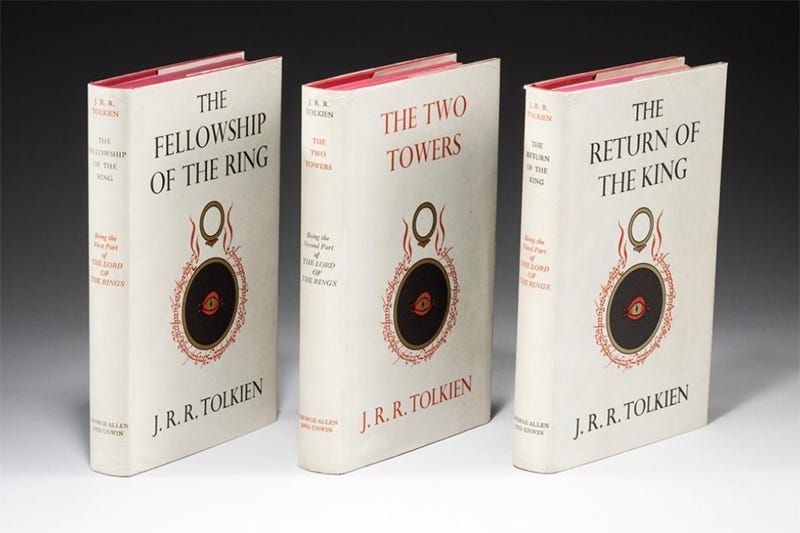
Occasionally, new criticism of old works emerges. Often, however, modern critics rehash already rebuffed talking points. Few critiques of Middle-earth and Narnia say anything new, which is why much of what was written around their publication responds to many modern criticisms.
Two popular objections in particular are directly stated and dismantled in Lewis’ effusive review of The Lord of the Rings — the characters have no moral ambiguity, and the book is a simple allegory.
No moral ambiguity
In his review, Lewis notes it is a “false criticism” to claim that the Middle-earth characters are “all either black or white.”
He points out that the climax of The Fellowship of the Ring, the first volume of the story, concerns the struggle between good and evil in the mind of Boromir.
“Motives, even in the right side, are mixed. Those who are now traitors usually began with comparatively innocent intentions. Heroic Rohan and imperial Gondor are partly diseased. Even the wretched Smeagol, till quite late in the story, has good impulses; and (by a tragic paradox) what finally pushes him over the brink is an unpremeditated speech by the most selfless character of all.”
No, it’s not that the characters are exclusively good or evil. Lewis says the objection arises because Tolkien recognizes a fixed standard of good or evil to which every character is held.
In The Two Towers, Éomer remarks about all the strange happenings in their current moment and asks, “How shall a man judge what to do in such times?”
Aragorn responds: “As he has ever judged. Good and ill have not changed since yesteryear; nor are they one thing among Elves and Dwarves and another among Men. It is a man’s part to discern them, as much in the Golden Wood as in his own house.”
Lewis points out, “This is the basis of the whole Tolkienian world.1 I think some readers, seeing (and disliking) this rigid demarcation of black and white, imagine they have seen a rigid demarcation between black and white people.”
That consistent sense of morality, one that stretches across time and cultures, is what some critics actually object to in Tolkien. They don’t find characters without moral ambiguity; they find a world without it.
A fixed moral world with characters exploring, confronting, dismissing, challenging, and excusing how their actions bump up against that morality not only enhances a compelling story; it reflects our world.
People criticize The Lord of the Rings, not because they don’t like the morality of that world, but because they reject Tolkien’s assertion that our world shares the same moral standards.
Simple allegory
Others may argue that The Lord of the Rings is just a simple allegory. When Tolkien wrote the story, he intended Mordor to represent Russia and the Ring to be the atomic bomb.
Lewis, who had encouraged Tolkien during much of the development process, knows this is false.
“How long do people think a world like his takes to grow? Do they think it can be done as quickly as a modern nation changes its Public Enemy Number One or as modern scientists invent new weapons? When Professor Tolkien began there was probably no nuclear fission and the contemporary incarnation of Mordor was a good deal nearer our shores.”
Lewis says that the way we can know we are reading myth and not allegory is that “there are no points to a specifically theological, or political, or psychological application. A myth points, for each reader, to the realm he lives in the most. It is a master key, use it on what door you like.”
Using myth to tell the story of Middle-earth allows Tolkien to enrich our world. “The value of myth is that it takes all the things we know and restores to them the rich significance which has been hidden by the ‘veil of familiarity.’”2
Lewis argued that myth enables us to see and appreciate our world even more. “If you are tired of the real landscape, look at it in a mirror,” he writes. “By putting bread, gold, horse, apple, or the very roads into a myth, we do not retreat from reality: we rediscover it. As long as the story lingers in our mind, the real things are more themselves.”
Tolkien was able to do more than give us a restored perspective on everyday objects, but on life itself. “This book applies the treatment not only to bread or apple but to good and evil, to our endless perils, our anguish, and our joys. By dipping them in myth we see them more clearly.”
By reading Lewis’ review of his friend’s work, we can also see the shallowness of many modern criticisms. The critics are trying to be daring and original, but, as Lewis writes in Mere Christianity, that is the quickest way to be trivial.
“Even in literature and art, no man who bothers about originality will ever be original: whereas if you simply try to tell the truth (without caring twopence how often it has been told before) you will, nine times out of ten, become original without ever having noticed it.”
Sources:
“Tolkien’s The Lord of the Rings” in On Stories and Other Essays on Literature
More from The Wardrobe Door
Coming soon
Lewis’ recognized the human desire for being original and standing out. He rightly understood that, paradoxically, the way to achieve originality is by becoming more like Christ.
Archive

Recent


I love that Lewis used his friend’s name to make up this word.
Similarly, when discussing why he wrote his own fairy stories, Lewis said he believed casting theological truths in a fantasy world would strip them of their “stained glass and Sunday School associations” and “steal past those watchful dragons.”