

The Silver Chair: Chapter 10 “Travels Without the Sun”
C.S. Lewis Read-Along, Vol. 4, Issue 11

Background: Drawing from Greek philosophy and classic literature, C.S. Lewis equips readers in this seemingly simple chapter of a children’s fairy tale with the tools to respond to a materialistic explanation of creation and a skeptical approach toward Scripture.
Quote: “Don’t you mind him,” said Puddleglum. “There are no accidents. Our guide is Aslan, and he was there when the giant king caused the letters to be cut, and he knew already all things that would come of them, including this.”
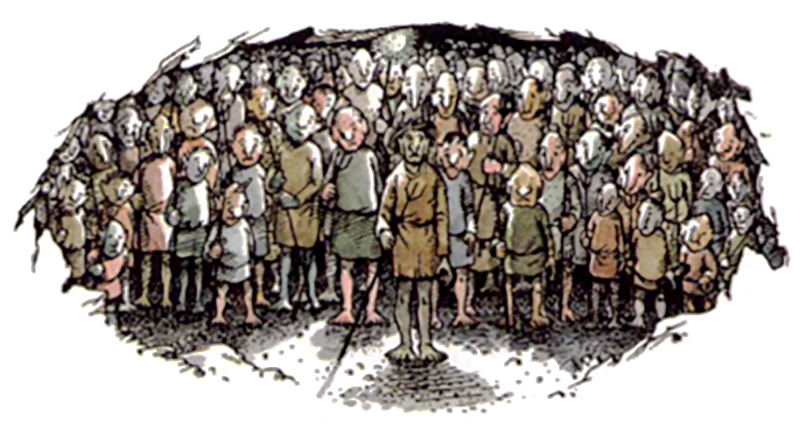
In “Travels Without the Sun,” Lewis draws from three of his favorite written works—Virgil’s Aeneid, Plato’s Republic, and Shakespeare’s Hamlet.
As this chapter opens, we immediately discover to whom the “pitch-black voice” from the last chapter belongs. “The Warden of the Marches of Underland” has come with “a hundred Earthmen in arms” on behalf of “the Queen of the Deep Realm” to apprehend Puddleglum, Eustace, and Jill.
Puddleglum explains that they fell down by accident, to which the warden responds with what will become a familiar refrain: “Many fall down, and few return to the sunlit lands.” Some variation or part of this is repeated six times in this chapter. This repeated phrase, spoken to heroes who have descended into the underworld, indicates that Lewis is thinking of the Aeneid.
Aeneas, the hero of Virgil’s epic, travels to the underworld. Before starting the journey, an oracle tells him that making it down is easy; it’s making it back up that’s the hard part.
The gates of hell are open night and day;
Smooth is the descent, and easy is the way:
But to return, and view the cheerful skies,
In this, the task and mighty labor lies.
Lewis scholar David Downing notes how similar this sounds to the warden’s repeated words in The Silver Chair and Screwtape’s description of the “safest road to hell.” Whether we realize it or not, as we are reading this chapter, Lewis is evoking hell and the place of the dead. Even the gnome army has the appearance of imps and demons.
But yet, Lewis doesn’t want us to see this place and these people as fully demonic. Jill “almost forgot to be afraid of them” because they looked so sad. And Puddleglum gives us our moment of levity by gleefully noting the somber gnomes could teach him to “take a serious view of life.”
Additionally, we know this is not fully hell because the blessing of friendship is still present. After Jill despised Eustace for his fear of heights at the beginning of their adventure in Narnia, she is confronted with her fear—claustrophobia. The gnomes demand they crawl into a “little dark crack,” and Jill begins to panic.1 She is forced into a type of her own personal hell, but Puddleglum and Eustace encourage her (even if Scrubb decides to remind her of when she made him fall off the cliff).
It brings to mind, if even in a contradictory way, one of Lewis’ famous quotes about friendship from The Four Loves. “Friendship is unnecessary, like philosophy, like art, like the universe itself (for God did not need to create). It has no survival value; rather is one of those things that give value to survival.”
Jill may question whether friendship has no survival value, as she manages, with the help of Puddleglum and Eustace, to make it through the crawl space and into a giant space that once again draws from the Aeneid and even some of Lewis’ earlier fiction writing.
