

The Horse and His Boy: Chapter 14 “How Bree Became a Wiser Horse”
C.S. Lewis Read-Along, Vol. 5, Issue 15

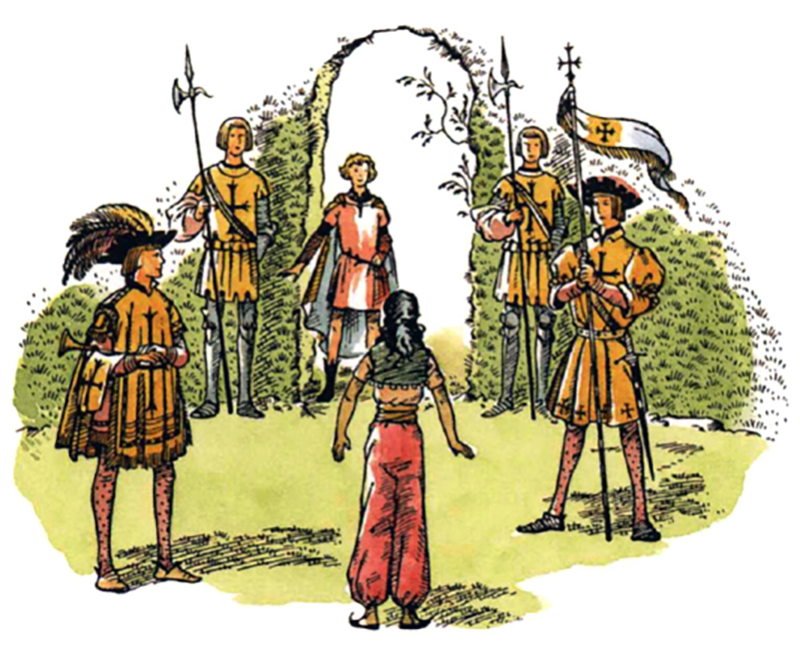
When people speak of biblical allusions in The Chronicles of Narnia, they don’t often mention The Horse and His Boy. But this story constantly alludes to Scripture, and this chapter might do so more than most.
“Now, Bree,” he said, “you poor, proud, frightened Horse, draw near. Nearer still, my son. Do not dare not to dare. Touch me. Smell me. Here are my paws, here is my tail, these are my whiskers. I am true Beast.”
Chapter 14 “How Bree Became a Wiser Horse”
The narrator brings us back to Aravis, Bree, and Hwin with the Hermit, who lets them know that Shasta did survive the battle. Once the fighting was over, however, seeing the events without hearing them was of little use.
The next day, Hwin announces that she is ready to head toward Narnia. The other two aren’t as sure. Aravis suddenly considers what her life might look like, as she will be away from all her Calormene family and friends and likely split from the found family she’s developed during this journey.
Bree’s concerns are much less serious. He wants to wait until his tail has grown back out, since he’d had it cut like a pack horse to try to sneak through Tashbaan. Both Hwin and Aravis gently mock him for his vanity.
As Bree objects, he says, “By the Lion’s Mane,” which prompts Aravis to ask about this phrase. Why would he swear by a lion if he hates lions so much? Bree says it’s related to Aslan, the great deliverer of Narnia, but he assures Aravis that Aslan is not a real lion.
While admitting that he was only a foal when he was kidnapped, Bree still confidently proclaims “in a rather superior tone” that Aslan could not actually be a lion.
No doubt, when they speak of him as a Lion they only mean he’s as strong as a lion or (to our enemies, of course) as fierce as a lion. Or something of that kind. Even a little girl like you, Aravis, must see that it would be quite absurd to suppose he is a real lion. Indeed it would be disrespectful. If he was a lion he’d have to be a Beast just like the rest of us.
Bree begins to explain how absurd it would be for Aslan to have “four paws, and a tail, and Whiskers!” But just then a whisker of Aslan, who had leaped into the Hermit’s enclosure, tickled Bree’s ear, and he shot across the lawn.
In exposing Bree’s ignorance, Lewis is confronting heresies old and new. In early Christianity, Docetism, which was closely related to Gnosticism, taught that Jesus only seemed to have a human body. Physical matter was inherently evil, so God could not inhabit a physical body.
Lewis saw the need to continually confront that heresy. He wrote an introduction to Sister Penelope’s translation of Athanasius’ On the Incarnation, which was reprinted as “On the Reading of Old Books.”1 We need to be reminded that most of the cultural questions we face are not new and have old answers.
In a November 1942 sermon, later adapted into the book Miracles, Lewis quotes Athanasius on why the Son of God, as fully God, became fully man.
