

The Horse and His Boy: Chapter 11 “The Unwelcome Fellow Traveler”
C.S. Lewis Read-Along, Vol. 5, Issue 12

“I was the lion.” With those words, C.S. Lewis reframes the entire story of The Horse and His Boy. He also encourages us to understand our own story very differently.
“I was the lion.” And as Shasta gaped with open mouth and said nothing, the Voice continued. “I was the lion who forced you to join with Aravis. I was the cat who comforted you among the houses of the dead. I was the lion who drove the jackals from you while you slept. I was the lion who gave the Horses the new strength of fear for the last mile so that you should reach King Lune in time. And I was the lion you do not remember who pushed the boat in which you lay, a child near death, so that it came to shore where a man sat, wakeful at midnight, to receive you.”
Chapter 11 “The Unwelcome Fellow Traveler”
When I first began planning this read-along, I thought this might be the time I could read this chapter of The Horse and His Boy without crying. Little did I know that I would be going through some significant challenges, including the death of my mom. The streak continues.

I wept multiple times reading this chapter. Not over being unfortunate or unlucky, as Shasta says, but over the goodness of a God who walks beside me through my dark times. Even when I don’t see Him, He’s there with me, guiding me safely to my destination. But let’s not jump ahead.
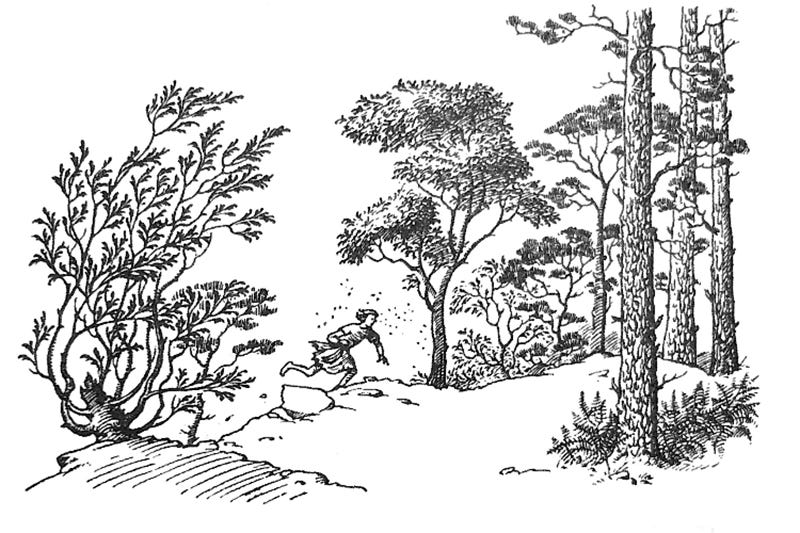
First, we find Shasta running through the woods to find and warn King Lune of Rabadash’s surprise attack. He’s going about the “harder and better” task that was his reward for his last good deed. Stumbling and sweating, Shasta hears a hunting horn and runs into a crowd of Archenlanders, including “the jolliest, fat, apple-cheeked, twinkling-eyed King you could imagine.”
Like the Narnians before him, King Lune instantly mistakes Shasta for his son, Prince Corin. Shasta quickly corrects him and tells him of Rabadash’s plot to take Anvard. Darrin is not quite as trusting of Shasta’s word as the king is. Still, Lune orders that they ride for Anvard and asks for Shasta to be given a horse.
After his weeks of riding Bree, Shasta quickly mounts the horse, prompting Darrin to “warrant there’s noble blood in him.” King Lune stares at Shasta with a “curious expression, almost a hungry expression” and notes, “His blood, aye, there’s the point,” before they all ride off.
While Shasta could mount a horse, he has no idea how to ride a normal, non-talking horse. He tries to see how everyone else was holding their reins. Unfortunately, he could never figure out exactly what to do. Eventually, his horse falls to the back and further away from the others. As they thunder toward Anvard, he trots through a thick fog that has rolled in.
He isn’t sure what to do, so he just continues slowly in the same direction before arriving at a fork in the road. Torn over which one to take to avoid Rabadash, he finally chooses and shortly hears the Calormene troops arrive at the same fork. They reiterate their plans to kill everyone in Anvard. Shasta holds his breath until he hears the horses marching down the other path.
Still unsure of what to do and where to go, Shasta decides to just go forward. “After all,” he says, “this road is bound to get somewhere.” Unfortunately, “somewhere” isn’t always where we need to be.
In Mere Christianity, Lewis writes that “progress means getting nearer to the place where you want to be. … If you are on the wrong road, progress means doing an about-turn and walking back to the right road.” In The Voyage of the Dawn Treader, a governor whines that ending the slave trade would set back progress. King Caspian says this type of progress is called “going bad” in Narnia.

But when we don’t know where we are going and even when we may be going in the wrong direction, we are not too far from God. Shasta has found himself inside the cloud on the mountain that has turned from gray to black “with alarming speed.”
In Exodus, the cloud that descends and rests on Mount Sinai, where Moses speaks with God, is described as “dense,” “thick darkness,” and like “smoke.” This cloud-covered mountain in Archenland will be the sight of Shasta’s divine encounter.
Drawing from Scripture,1 Lewis’ writing frequently connects mountainous heights with longing, joy, and God’s presence.
