

Father Christmas Belongs in Narnia
J.R.R. Tolkien should've recognized C.S. Lewis’ goal.

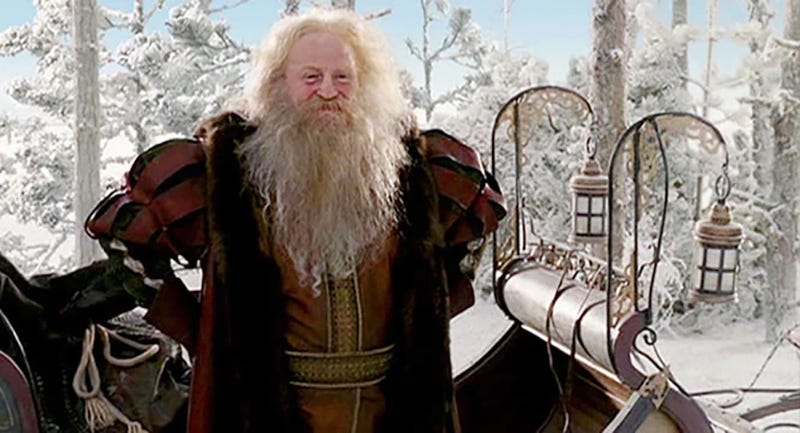
For many, the inclusion of Father Christmas in The Lion, the Witch and the Wardrobe is a bridge too far. They assume this is just another example of C.S. Lewis cramming in random mythological creatures with no rhyme or reason. J.R.R. Tolkien famously criticized Narnia for this reason, but Lewis was making a Christmas connection similar to one Tolkien made.
In The Lord of the Rings, the fellowship leaves Rivendell on December 25. Additionally, their mission is accomplished on March 25, the traditional date of Jesus’ crucifixion. Through his calendar dating, Tolkien connected his story to the church calendar. By starting the journey on Christmas Day, he’s marking the beginning of good triumphing over evil. Suffering will still happen, but in the end, darkness will be defeated. The rightful king will reign.
The Narnia link was slightly more explicit than Middle-earth’s, yet Tolkien still seemed to miss it (or at least not appreciate it).1 The inclusion of Father Christmas in Narnia tells the same story as the fellowship beginning their trek on December 25. The days of evil are numbered, and the true king will soon be on the throne.
In the chapter “The Spell Begins to Break” of The Lion, the Witch and the Wardrobe, note what Father Christmas says:
I’ve come at last. She has kept me out for a long time, but I have got in at last. Aslan is on the move. The Witch’s magic is weakening.
Before this moment, Narnia is in a perpetual Advent of “always winter and never Christmas” because of the White Witch’s rule. Father Christmas signals to the reader that the time of waiting is over. Christmas is come because “Aslan is on the move.”
While we know this is not the first time Aslan has arrived in the history of Narnia, he was there at the creation in The Magician’s Nephew, this is his first appearance within the Narnia story.2 It serves as Aslan’s incarnation story.
