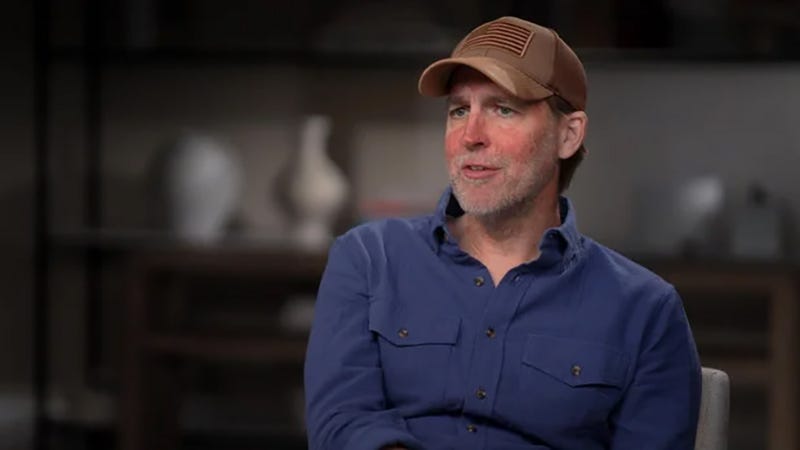
Ben Sasse Is Teaching Us How to Die
“I don’t feel ready. But to whom would I go?”
Last year, Ben Sasse was diagnosed with pancreatic cancer and given a few months to live, but thanks to “Providence, prayer, and a miracle drug,” he’s still alive.
While that drug has extended his life, it has not (at least yet) changed his long-term fortunes. Barring an actual miracle, he will die soon.
You may remember Sasse as a senator from Nebraska or the president of the University of Florida. But if you’d ask him, he’d say those former titles rank low on his list, especially now that he is living on essentially borrowed time.
Recently, Sasse has been doing numerous interviews.1 I have to believe that he’d rather be spending every second of his time remaining with his family. But likely, these public interviews will be a blessing and comfort to his loved ones in the coming years. They have certainly been a testimony to the world about what it means to live and die.
The more I listened to his interviews, the more I remembered why I was such a fan of Sasse politically and philosophically. He embodies the idea, not of a politician, but of a civil servant.
In a very real way, he is now serving the public by giving us a good and godly perspective on this life and what comes after it.
He embodies C.S. Lewis’ sentiment about being heavenly-minded. “If you read history, you will find that the Christians who did most for the present world were just those who thought most of the next,” he writes in Mere Christianity.
“It is since Christians have largely ceased to think of the other world that they have become so ineffective in this. Aim at heaven and you will get earth ‘thrown in;’ aim at earth and you will get neither.”
Sasse is aimed at heaven and is making a difference here on earth by reminding us that there is so much more than what is here on earth.
“I did not decide to die in public,” he told Ross Douthat. “I obviously ended up with a calling to die, but there’s time to redeem. It is not how things are meant to be. But it is great that death can be called the final enemy. It’s an enemy, but it’s a final enemy, and there will then be no more tears. I believe in the resurrection, and I believe in a restoration of this world.”
In his interview with Sasse, Douthat spoke of a previous guest, Bart Ehrman, the New Testament scholar and skeptic. Ehrman says he rejected the evangelical Christianity of his youth because of the problem of evil and human suffering. He claimed unanswered prayers are evidence against God’s existence.
Sasse said he prayed for a miracle, but even if he didn’t receive that it wouldn’t change his view of God.
I wouldn’t want a sovereign God to defer to all of my prayers with a yes, because I’m not omniscient. I don’t know what the weaving together of the tapestry of full redemption should look like, but I going through the period of suffering that I’m going through is a benefit, because it is a winnowing. I’m filled with dross and this suffering is not salvific. But it’s sanctifying, and I’m grateful for it.
Douthat asked him if he was ready to die.
I don’t feel ready. But to whom would I go? I have confidence that when Jesus says to the disciples he didn’t want to be identified as the Messiah yet, keep these crowds away. … But he says you can’t keep the children from me. And we’re told that we get to approach the Almighty. We get to approach the divine and call him Daddy, Abba, Father? That’s pretty glorious. And I know that that’s what I need.
In another recent interview with 60 Minutes, Sasse said his last wish for the country that he loves and leaves behind is to deliberate more about our mortality and therefore “get back to wisdom about what living a life of gratitude looks like.”
Scott Pelley asked him about his faith and why Sasse believed God put him to this test. He made clear that death was evil, but the diagnosis has also been “a touch of grace because it forces me to tell the truth [about my own mortality and brokenness]. … I hate cancer, but I’m also grateful for it.”
Asked if cancer has made him closer to God, Sasse responded, “Definitely because I can acknowledge my dependence in a new way.”
Fighting back tears discussing the next phases of life he is going to miss with his wife and three children, Sasse said, “But it’s not a surprise to God.”
Pelley, who was also emotional in the interview, asked him if he believed God had a plan. “Absolutely,” Sasse replied. Alluding to an R.C. Sproul quote, he noted, “There are no maverick molecules in the universe.”
In Lewis’ final months, one of his frequent correspondents wrote to him with fears of death. Lewis had endured the death of his mother when he was a young boy and, more recently, his wife—both from cancers. He fought in the death-filled trenches of World War I and endured the tragedy of World War II.
Much like Sasse, Lewis sought to focus her attention beyond herself and beyond this world. “Has this world been so kind to you that you should leave it with regret?” he asked. “There are better things ahead than any we leave behind.”
In a culture obsessed with achieving maximum comfort in this world and avoiding the reality of death, Sasse is showing us what it means to suffer and die well. His temporal life is fixed with an eternal aim to those “better things”—to hear, “Well done, good and faithful servant.”
Someday, probably soon, Ben Sasse will hear those words. In the meantime, we are blessed to hear his words.
More from The Wardrobe Door
Archive
Recent
Elsewhere
9 Discouraging Trends for Global Christianity in 2026 — Lifeway Research
If you haven’t heard his interviews, I’d encourage you to watch the two linked here and find some of the others. He offers great insight into what’s broken politically, what’s coming culturally, and what changes need to be made societally.


Both interviews are so good.