

The Modern Day Lewis Has a New Book
Door Jam: April 20, 2026

The Bishop of Durham Attempts to Surrender the City by Susanna Clarke is releasing later this year. I’ve already preordered it.

If you know me or have read this newsletter for any length of time, you know I wouldn’t throw around a title like “modern day C.S. Lewis” lightly. But I do believe Clarke fits that label as well as any writer could.
Her debut novel, Jonathan Strange & Mr. Norrell, tells an alternative history of 19th-century England, where magic, frequently studied but long since absent in practice, has returned. The Bishop of Durham is set 700 years before the events of Jonathan Strange & Mr. Norrell.
During the conquest of Northern England, the fairy host sweeps across the countryside. The city of Durham finds itself surrounded. But the encircling forces are not fairies, nor even other humans, but trees that trap the city within an eerie wood.
Ranulf, Bishop of Durham—a consummate politician—understands that the survival of the Northern English people depends on his finding a way to unite the two races, human and fairy. And he's not averse to improving his own position at the same time. With these aims in view, he sets off for the New Castle, in search of the new King—the leader of the fairy host, rumored to be a mysterious human boy, no more than fourteen years old, who speaks no word of any human language.
There are hints at Narnia and Lewis in Jonathan Strange & Mr. Norrell. One scene was an homage to Maugrim lying on the door of the White Witch’s castle, but she didn’t make the connection until later. She said Lewis provided the “furniture for the inside of [her] head.”
Clarke has said that her imagination works more like Lewis’ than Tolkien’s. But Jonathan Strange & Mr. Norrell reminds me more of Tolkien. It has footnotes about historical facts and books that only exist in the world of the story. She had recently reread The Lord of the Rings before writing it and was inspired to “write a novel of magic and fantasy.”
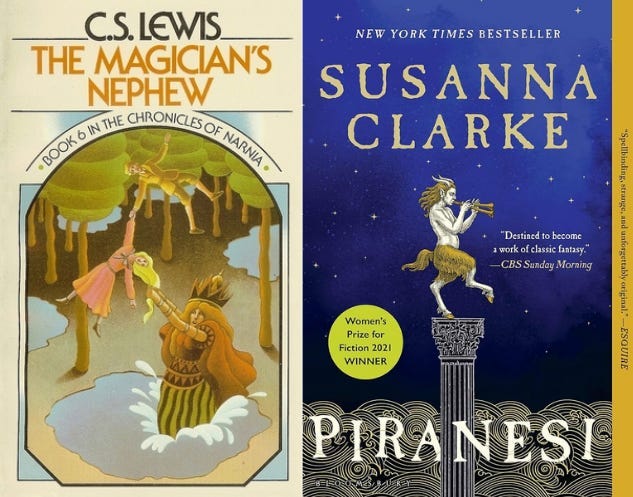
Her second novel, Piranesi, is much more Lewisian, however. She’s spoken of how much the book borrows, directly and indirectly, from the Narnia series, especially The Magician’s Nephew.
The book begins with a quote from the Narnia prequel. One character takes their name from a character from The Magician’s Nephew, even hinting that he could be a descendant. The book’s setting is inspired by both The Wood Between the Worlds and Charn.
Her books aren’t as obviously Christian as Lewis’ works, but much like Tolkien’s, the language, symbols, and concepts of the faith clearly underpin Clarke’s stories.
In a recent conversation about Lewis and his books, she spoke about her connection to him at an early age.
The [Narnia] books were always there in my home. My mother had been an English undergraduate at Oxford, and she’d actually been to Lewis’ lectures, although she said they came immediately after something else she had to do, so she was always late, so she was always in the back, so she never really heard what he said, which was a bit unfortunate. But my father was a Methodist minister, so he was very interested in the Christian side, so we always had Lewis’ books at home. And I don’t know how old I was when I read them, but they sort of became the primary books for me. The books I compared all other books to. … I think when I first read them, we were living in a very small mining town in Staffordshire in the late ‘60s, early ‘70s. It wasn’t particularly exciting. And Narnia became almost like my real home, or at least books following on from Narnia, books became my real home. That was where I lived.
In the video, you can also hear her read the passage where Digory encounters Aslan in The Magician’s Nephew.
Not Safe But Good
C.S. Lewis quote of the week
Symbolism exists precisely for the purpose of conveying to the imagination what the intellect is not ready for.
The Collected Letters of C.S. Lewis, Volume 2: Books, Broadcasts, and the War, 1931-1949
The Problem of Printers
Bad C.S. Lewis book covers
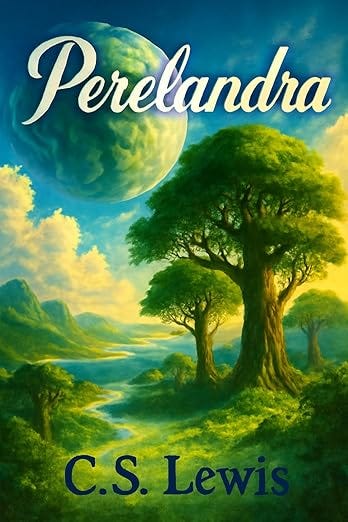
I have no idea what’s happening in this obviously AI-generated cover, but it has no connection to what happens in Perelandra, other than green being a very prominent color.
Behind the Wardrobe
Sneak peek at the bonus articles
Carey Mulligan is “maybe” in Narnia
Gerwig set for a repeat “Barbenheimer” phenomenon with Narnia on Christmas Day
Where to start with C.S. Lewis
What Philip Pullman gets wrong about Narnia
New Lord of the Rings movie finds its new Aragorn
The WWI relationship Tolkien captured in The Lord of the Rings
What two words define The Lord of the Rings movie trilogy?
And more!
