

The Magician’s Nephew: Chapter 4 “The Bell and the Hammer”
C.S. Lewis Read-Along, Vol. 6, Issue 5

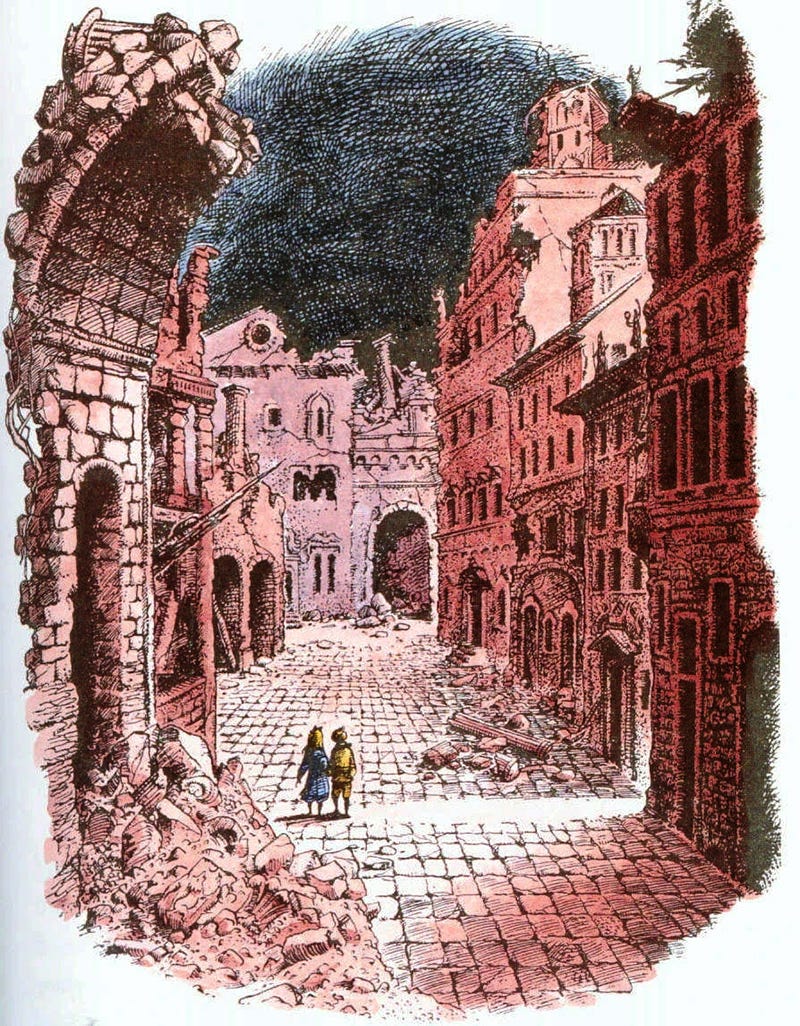
Digory and Polly find themselves on a dying world in a ruined castle with little to explore until they discover a room filled with what looked like wax figures, a bell, a hammer, and a sign.
Despite his earlier bravery in going after Polly, Digory shows he could easily become like his uncle. Our individual, everyday choices matter because of the trajectory they set for our lives.
Chapter 4 “The Bell and the Hammer”
Once again, Digory and Polly seemingly rush across space before standing on a new world. The light seems wrong with a sky that was “extraordinarily dark—a blue that was almost black.” Digory has an inquisitive attitude, but Polly immediately feels differently. Twice she says, “I don’t like this place.”
This is the first time in a Narnia story that characters have gone outside of our world to some place that seems off. Travelers have either ended up in Narnia, Aslan’s Country, or the Wood Between the Worlds. Even the frozen Narnia under the White Witch’s rule had a magical feeling. There was still life beneath the ice. Not so in this world.
This subverts the expectations of the reader, assuming we would end up in Narnia. Instead, we go to this dead world, which we later learn is a called “Charn.” We’ll discuss the specifics more next week, but this is the opposite of the other planets Lewis creates in the Ransom Trilogy.
Perelandra is a new world, full of life. Even Malacandra, though it is older and closer to dying, has living creatures and life-giving purpose. This world is only full of ruins and decay. The children don’t see any living things—no ants or spiders, no grass or moss.
Most of the chapter establishes the atmosphere and vibes of this new world, but also our established characters. Like the forest they just came from, everything is silent on this planet, but it’s a different silence. Not one that is “rich and warm,” but a “dead, cold, empty silence.”
In this place, Polly’s pull toward safety becomes more prominent, but so too does her desire to appear brave despite her worries. More troubling, however, is Digory’s temptation to follow his uncle’s path.
