

The Magician’s Nephew: Chapter 13 “An Unexpected Meeting”
C.S. Lewis Read-Along, Vol. 6, Issue 14

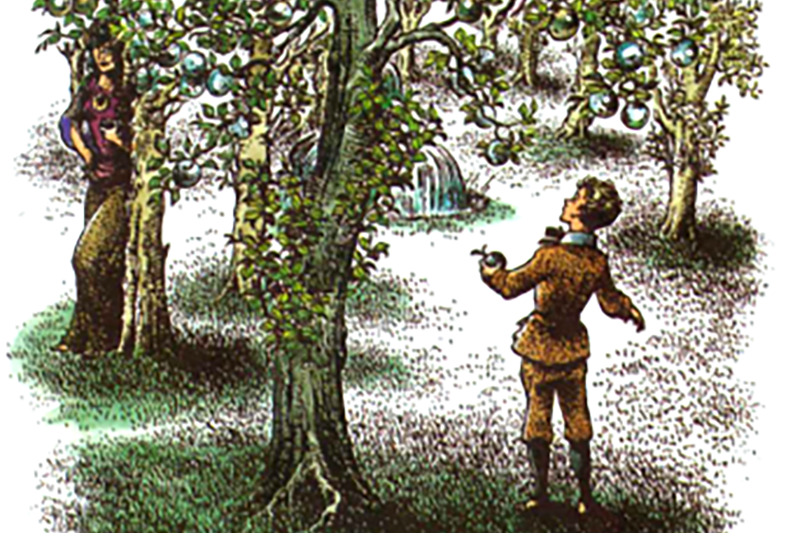
In writing his own garden scene, C.S. Lewis draws on a multitude of biblical and literary inspirations because he wants to push us deeper to find wisdom in ancient texts. But within his own story, he gives us a perspective on temptation that can help us navigate those moments in our own lives.
Chapter 13 “An Unexpected Meeting”
I love the Christmas morning like joy that overtakes Polly when she sees the toffee has turned into a tree. In his sovereignty—worked out through circumstances and their actions—Aslan has taken care of them.
But the simple pleasures they enjoy in the early part of this chapter serve as a good balance to the temptation that is about to emerge. It is not wrong to enjoy the blessings in this life. It is wrong to place them as the ultimate goal of this life.
Screwtape rightly warns Wormwood of the danger to the demonic side when dealing with pleasure.
“Never forget that when we are dealing with any pleasure in its healthy and normal and satisfying form, we are, in a sense, on the Enemy’s ground. I know we have won many a soul through pleasure. All the same, it is His invention, not ours. He made the pleasures: all our research so far has not enabled us to produce one. All we can do is to encourage the humans to take the pleasures which our Enemy has produced, at times, or in ways, or in degrees, which He has forbidden.”
The children enjoy the delicious toffee fruit and appreciate the “wonderful ride” on Fledge’s back until they spot “the Place.”
Before we discuss the garden scene for our edification, I first want to explore it from Lewis’ inspiration. In creating this garden, he draws from numerous pieces of mythology and literature.
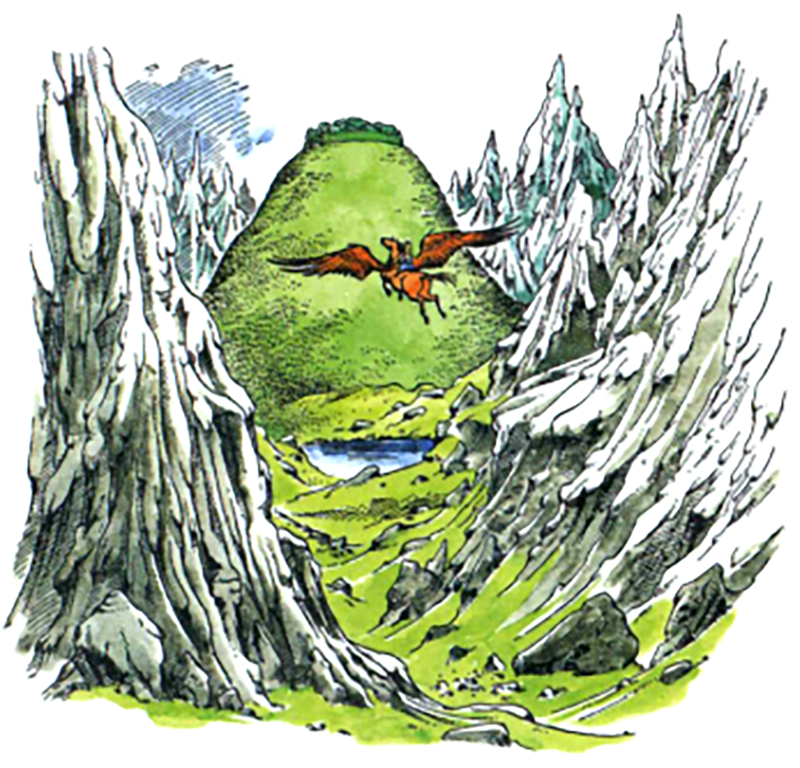
Anyone vaguely familiar with the Bible will note the allusions to the Garden of Eden, the tempting of Eve, and the Fall of man. Beyond that, Lewis draws heavily from Dante’s Divine Comedy, which places the biblical garden at the top of Mount Purgatory.
He also has in mind Greek and Norse mythology. In the Greeks’ garden of the Hesperides, a hero is sent to retrieve an apple from the garden that has the power to make someone immortal, but a female villain steals another apple.1
In Norse mythology, Yggdrasil is the tree of life. At the top of the tree, an eagle, famous for its knowledge, roosts. Digory observes a bird at the top of the tree in the garden, which he links to someone always watching and knowing what you might be doing.
Much of Lewis’ imagery and depiction of the garden comes from John Milton’s Paradise Lost. In it, Eden is a walled garden at the top of a green hill. The garden has one gate facing east for entry. Instead, the tempter climbs over the wall and eats the fruit before trying to tempt others.
You will find more of this imagery across Lewis’ writings. Perelandra delivers an inverse of the Fall, but on Venus. Within Narnia, The Horse and His Boy has children reach the walled garden after their wilderness wanderings.
This garden specifically is recalled in The Last Battle, where those who are true Narnians are taken to Aslan’s Country, which has an idealized version of the garden at its center. Except in this perfect garden, the fruit is gold instead of silver.
The Magician’s Nephew garden may also be the garden referenced in The Voyage of the Dawn Treader, where Aslan takes Eustace in his dragon form to be reborn. Eustace wasn’t sure if it was a dream or not, but he says Aslan took him to “the top of a mountain I’d never seen before and on the top of this mountain there was a garden—trees and fruit and everything.”
Why does Lewis borrow so liberally from the works that inspired him in so many of his works? For starters, he saw it as a way to encourage people to read old books. He hoped readers would continue to chase the story back further and investigate the inspiration.
In the essay, “On the Reading of Old Books,” he wrote, “It is a good rule, after reading a new book, never to allow yourself another new one till you have read an old one in between.”
He valued older books because they offered us a different perspective. Modern books, he said, either give us truths we already half knew or spread dangerous popular errors. “The only palliative is to keep the clean sea breeze of the centuries blowing through our minds, and this can be done only by reading old books.”
But even beyond that philosophical reason, Lewis had a theological justification for frequently echoing writing that he loved. In the essay “Christianity and Literature,” he points out that while modern critical theory emphasizes originality and self-expression, the New Testament calls us to imitate. Paul will say to “imitate me as I imitate Christ.” Jesus calls us to imitate Him, while saying that He does nothing but what He sees the Father do.
In the essay, Lewis argues that if a Christian’s “talents are such that he can produce good work by writing in an established form and dealing with experiences common to all his race, he will do so just as gladly. I even think he will do so more gladly.”
But now that we’ve peeked behind and beyond this chapter, let’s discuss what Lewis wrote in the chapter.
