


Welcome to our fall C.S. Lewis read-along. For the next few months, we’ll be going chapter-by-chapter through The Last Battle. This introduction is open to everyone. The upcoming full chapter discussions will only be available for paid subscribers.
The Last Battle describes the end of Narnia and deepens the connections between it and our world, so let’s explore those connections together. What works, events, and people contributed to the book? What was C.S. Lewis trying to “sneak past the watchful dragons” of the reader? What can we draw from the books for our own lives?
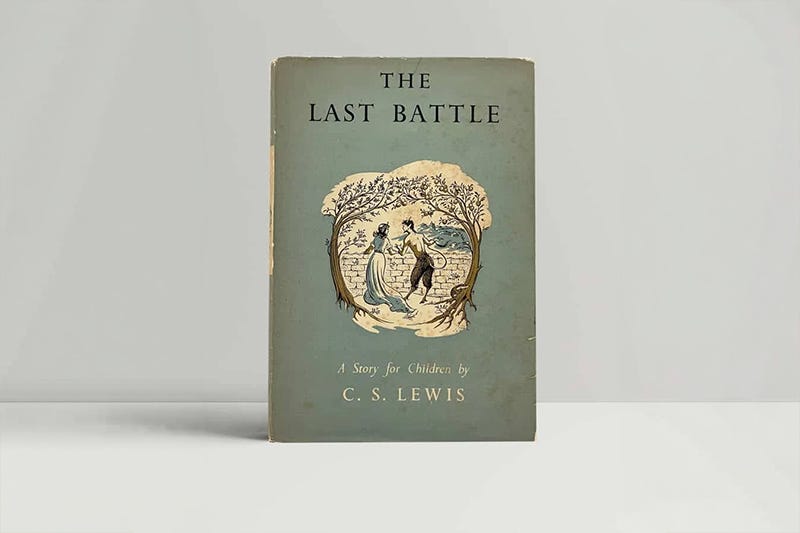
The Last Battle Fast Facts:
Published on September 4, 1956
Written in a few months from the end of 1952 to early 19531
Has the same subtitle — “A Story for Children” — as The Lion, the Witch and the Wardrobe, indicating that the two books should serve as the first and last books in the series
Only Narnia book without a dedication
Last book chronologically and the only book whose number stays the same in the publication and chronological reading orders
Takes place in Narnia year 2555 and Earth year 1949
Won the Carnegie Medal, the British equivalent of the Newbery Medal, as the year’s best children’s book2
Spoiler warning: If you haven’t read The Last Battle, the discussion below will reveal many plot points of the book through the end.
Soon, you’ll no longer have access to our The Last Battle read-along. Become a paid subscriber so you don’t miss any of the discussion.
Join now for 20% off for one year. That will take you through this read-along and into special coverage of Gerwig’s upcoming Narnia movie.
Context of The Last Battle
With The Magician’s Nephew, we discussed how Lewis struggled to complete Narnia’s creation story. He didn’t have similar trouble with the end of Narnia in The Last Battle. In fact, he finished The Last Battle before The Magician’s Nephew.3
Immediately after finishing The Lion, the Witch and the Wardrobe, Lewis attempted to write the creation of Narnia and tell how the lamp post came to be in those woods. By June 1949, he had two chapters finished.
But the story bogged down, so he left it behind. Lewis then quickly wrote Prince Caspian, The Voyage of the Dawn Treader, The Silver Chair, and The Horse and His Boy over the next several years.
He returned to The Magician’s Nephew and finished three-fourths of it, but it wasn’t a polished story. So, he left it behind again to finish other projects. He turned in the manuscript to his major academic work, English Literature in the Sixteenth Century, and began working on The Last Battle in the fall of 1952.
Around that same time, he returned from a trip to Ireland and met someone who would change his life. Joy Davidman Gresham, who had been writing to him from the U.S., arrived in the U.K. and the two met in person for the first time. She spent much of the Christmas holiday at the Kilns with the two Lewis brothers.4
While they enjoyed her company, there was a misunderstanding and what they thought was a one-week stay turned into three weeks. The Belfast-born brothers were not prepared for the New York woman who “talks from morning till night.”
Still, her influence on his writing begins during this time. In discussing the possible title of what will eventually become The Silver Chair in a September 1952 letter with a friend, Lewis mentioned her opinion.5
His letters during that time period also demonstrate he was wrestling with many of the theological issues that arise in The Last Battle, either from his own contemplation or questions asked by letter writers. What happens after death to those who never heard the name of Jesus?
At the same time, a tragedy struck in Britain that surely inspired a key detail of Lewis’ final Narnia story. On October 8, 1952, a three-train collision in the greater London area killed 112 people and injured more than 340.6
The Harrow and Wealdstone rail crash remains the second deadliest train incident in British history and the worst peacetime crash. This event likely gave Lewis the idea for how to end the book and ensure all seven of the Friends of Narnia, along with Mr. and Mrs. Pevensie, entered Aslan’s Country at the same time.
With all those incidents and issues rolling around in his mind, Lewis wrote the final Narnia book quickly, like he did with most of the other Narnia stories. But he struggled for a long time on what to call it, like he did with most other Narnia stories.7
In April 1954, he wrote to a young American girl who had read the first four books. He told her that three more would be released: The Horse and His Boy, which would come out later that year, The Magician’s Nephew, which was at the printer, and the final book, which was already written but “only in pen-and-ink.”
He said he had not yet decided on the name of it but was deciding between two options “The Last King of Narnia” and “Night Falls on Narnia.”8 Graciously, he asked the little girl which she liked best. Of course, he decided to go with neither of those names, though both phrases are in the book.
By early 1955, he had landed on The Last Battle … tentatively. Writing to another young reader about the Narnia books were still to come, Lewis said The Magician’s Nephew was next and then “The Last Battle (at least I think that will be the name, but I might change it).”
Content of The Last Battle
Despite what some may say, the Narnia books are not an allegories. Lewis did not intend to have everything in the series have a one-to-one correspondence in our world. He did write an allegory, The Pilgrim’s Regress, but these books aren’t that.
Instead, Lewis called it a “supposal.” It answers the question: “Suppose there were a world like Narnia and supposing it needed rescuing and the Son of God (or the “Great Emperor oversea”) went to redeem it, as he came to redeem ours, what might it, in that world, all have been like?”
Yet, he states the “whole Narnian story is about Christ.” We read the books wrongly or at least miss out on much of their meaning if we don’t see Christ in the pages.
Thankfully, Lewis wrote to children to explain the Christological lens for each story. Unsurprisingly, The Last Battle is meant as a supposal for the end of the world in Narnia.
In 1960, he wrote to one girl that “the Ape and Puzzle, just before the last judgement (in The Last Battle) are like the coming of Antichrist before the end of our world.” The next year, he told another young girl that The Last Battle was about “the coming of Antichrist (the Ape). The end of the world, and the Last Judgement.”
Quite clearly, we are meant to read The Last Battle as in conversation with the book of Revelation and Jesus’ description of the last days in the Gospels (Matthew 24, Mark 13, and Luke 21). It’s not only a depiction of end times in the Bible, but it does draw heavily from it. The book also has numerous other biblical allusions that we could miss.
Additionally, we see bits from some of Lewis’ other beloved stories. There are elements of Richard Wagner’s musical epic The Ring of the Nibelung, particularly “Twilight of the Gods” which tells the story of Ragnarök, the end of the world and its renewal in Norse mythology.
As always, there are echoes of George MacDonald, evocations of Plato, and autobiographical elements, some of which show up in surprising places.
But the reading that most helps us understand The Last Battle is likely all that Lewis wrote elsewhere. It’s why Owen Barfield said that “what [Lewis] thought about everything was secretly present in what he said about anything.”
Owen Barfield said that “what [Lewis] thought about everything was secretly present in what he said about anything.”
When we read Lewis elsewhere, we see many of the same themes and truths that he develops and explores in The Last Battle.
Obviously, there are numerous references to previous Narnia books. Knowing he was ending the series allowed him to draw from all that came before The Last Battle. Some of his other fiction like The Great Divorce, The Screwtape Letters, That Hideous Strength, and Till We Have Faces also gives insight.
But we can also look to Lewis’ nonfiction writing for a deeper understanding of The Last Battle. In its discussion of the importance of language and morality, The Abolition of Man contrasts who humans are meant to be with a “trousered ape.” Mere Christianity raises important points about salvation that is salient to the conversation of who makes it to Aslan’s Country. Many of his essays flesh out points he makes in the story.
When Lewis weaved the many threads of his imagination and philosophy into the tapestry of The Last Battle, in his book Planet Narnia, scholar Michael Ward suggests that Lewis was doing so to communicate the theme of Saturn, the god of time and a signifier of death and destruction. We see Saturn’s literal embodiment in the book as Father Time.
Yet, Ward says, Lewis does not leave us under the sway of Saturn in The Last Battle. As Aslan returns and ushers everyone into his kingdom, Ward says the kingly spirit of Jupiter returns to rule and reign over the final chapters.
That is the ultimate reminder when reading The Last Battle. One day there will be a final battle. We may feel beaten and broken, but, in Christ, we will be victorious. Despite all that goes wrong in this life, we will begin a life where everything goes right, when we can’t be afraid even if we try.
Everything else—all the bumps and bruises, even all the persistent problems and deep tragedies—will have just been the cover and title page. We will then enter chapter one of the Great Story. Our imaginative time in Narnia and physical time on this fallen Earth will end, but that story and that new creation will never end.
Controversies surrounding The Last Battle
Before we start The Last Battle, we should at least mention that this is the most controversial Narnia story—for numerous reasons.
It’s much darker compared to the other Narnia books. There are substantially more deaths, including all the protagonists introduced at the beginning of this story and most of those introduced earlier in Narnia. This may be why Lewis chose not to dedicate the book.
Fantasy author and Lewis critic Philip Pullman has broadly condemned the Narnia series, once calling it “one of the most ugly and poisonous things I’ve ever read.” Pullman and many others have also repeatedly criticized Lewis over what has been called the “Problem of Susan,” which comes to a head in The Last Battle.
The eldest Pevensie daughter is not with her siblings as they enter Aslan’s Country because, in part, she has become “interested in nothing now-a-days except nylons and lipstick and invitations.” Critics say this epitomizes Lewis’ misogyny or his prudishness.
Others, often from the opposite philosophical perspective, dislike the inclusion of Emeth, the Calormene soldier, in Narnia. He spent his whole life serving Tash but Aslan says that all Emeth did for Tash was actually service to Aslan. Some say Lewis is advocating for universalism.
Additionally, some accuse Lewis of racism through his depiction of the Calormene as the evil, foreign invaders. Narnians disguise themselves by applying dark makeup and require a special treatment to become “white Narnians again.” Later, the dwarfs yell a skin-color-related slur, “Darkie,” at the Calormenes.
Each of those issues deserve deeper discussion that we will do as we go chapter-by-chapter through the book. With Susan and Emeth particularly, I’ll devote an extra article those weeks to discuss the issues surrounding them.
Certainly, Lewis is not perfect. Some of the choices he made would not be choices I would make today (not that I am the standard of perfection either). They may not even be choices he would make were he writing today. But many of the criticisms say more about the critic than they do about Lewis.
We’ll see this and more as we go further up and further in The Last Battle.
Next time: Chapter 1, “By Caldron Pool”
Further up and further in
Resources used:
Books by C.S. Lewis
The Collected Letters of C.S. Lewis, Volume 1: Family Letters, 1905-1931 — Editor: Walter Hooper
The Collected Letters of C.S. Lewis, Volume 2: Books, Broadcasts, and the War, 1931-1949 — Editor: Walter Hooper
The Collected Letters of C.S. Lewis, Volume 3: Narnia, Cambridge, and Joy, 1950-1963 — Editor: Walter Hooper
Books about C.S. Lewis
C.S. Lewis: The Companion and Guide — Walter Hooper
Past Watchful Dragons: The Origin, Interpretation, and Appreciation of the Chronicles of Narnia — Walter Hooper
Companion to Narnia: A Complete Guide to the Magical World of C.S. Lewis’ The Chronicles of Narnia — Paul Ford
Into the Wardrobe: C.S. Lewis and the Narnia Chronicles — David C. Downing
Planet Narnia: The Seven Heavens in the Imagination of C.S. Lewis — Michael Ward
The Narnia Code: C.S. Lewis and the Secret of the Seven Heavens — Michael Ward
The Keys to the Chronicles: Unlocking the Symbols of C.S. Lewis’ Narnia — Marvin Hinten
The C.S. Lewis Readers’ Encyclopedia — Editors: Jeffrey Schultz, John G. West, Jr.
Becoming C.S. Lewis: A Biography of Young Jack Lewis — Harry Lee Poe
The Making of C.S. Lewis: From Atheist to Apologist (1918-1945) — Harry Lee Poe
The Completion of C.S. Lewis: From War to Joy (1945-1963) — Harry Lee Poe
C.S. Lewis: A Life — Alister McGrath
The Narnian: The Life and Imagination of C.S. Lewis — Alan Jacobs
C.S. Lewis: A Biography — Roger Lancelyn Green, Walter Hooper
The Fellowship: The Literary Lives of the Inklings: J.R.R. Tolkien, C. S. Lewis, Owen Barfield, Charles Williams — Philip and Carol Zaleski
Works by others
The Lord of the Rings — J.R.R. Tolkien
The Ring of the Nibelung — Richard Wagner, John Deathridge (trans.)
Articles
“Lewis in the Dock: A Brief Review of the Secular Print Media's Judgment of the C.S. Lewis Centenary,” Inklings Forever: Published Colloquium Proceedings 1997-2016: Vol. 2, Article 6 — Richard James
“The Dark Side of Narnia,” The Guardian — Philip Pullman
Podcasts
Wade Center Podcast “Into Narnia, Vol. 6, The Magician’s Nephew” — Marion E. Wade Center, Wheaton College
The C.S. Lewis Podcast with Alister McGrath “#23 The Magician’s Nephew” — Premiere Insights
Previous articles in the C.S. Lewis read-along:
Entries for The Lion, the Witch and the Wardrobe, Prince Caspian, The Voyage of the Dawn Treader, The Silver Chair, The Horse and His Boy, and The Magician’s Nephew.
During this time, Tolkien wrote to Lewis to let him know that The Lord of the Rings would be published.
Narnia illustrator Pauline Baynes congratulated Lewis on the award. In a May 1957 letter, he thanked her but said “is it not rather ‘our’ Medal? I’m sure the illustrations were taken into consideration as well as the text.”
This is a case of the last being first and the first being last.
Earlier that year, before Lewis met Joy, who would become his wife, he had to deal with a woman pretending to be his wife and racking up bills under his name. He had to testify in her court case and eventually went to visit her in jail.
She and Warnie Lewis both liked “The Wild Waste Lands,” but the publisher and this friend disliked that idea.
Abbie Sweetwine, an African American nurse with the United States Air Force, was called “The Angel of Platform 6” by a British paper for her service during the aftermath.
He wrestled with The Silver Chair until after the galleys of the book were printed. In September 1952, he was debating between (and arguing with his publisher over) calling it “The Wild Waste Lands,” “Night Under Narnia,” “Gnomes Under Narnia,” or “News Under Narnia.”
“Night Under Narnia” was one of his possible names for The Silver Chair, but the publisher felt it was “too gloomy.”