

‘Odyssey’ Shines as Reflection of the True Myth
In Nolan’s latest film, Christian morality holds sway over Greek mythology.


Spoiler-free reflections on The Odyssey
Homer’s The Odyssey is often cast as the epic poem in Western Civilization. Christopher Nolan’s The Odyssey cannot reach such epoch-defining heights, but it does stand out as an epic film for our time.1
The Odyssey, much like Nolan’s most recent film Oppenheimer, is an apocalyptic film. It is the story of man who achieves victory through his ingenuity but also his hubris and must deal with all he has unleashed on the world.
The key to understanding Nolan’s latest cinematic masterpiece is Tom Holland—not the actor who portrays Odysseus’ son Telemachus, but the historian who wrote Dominion, the exploration of how Christianity reshaped Western morality.
Nolan’s The Odyssey is a modern retelling and reshaping of the classic Greek epic, but it is not best seen and understood through a 21st century progressive lens. Rather, the story comes to us by passing through the moral sensibilities of the 1st century church.
C.S. Lewis came to understand the great myths as symbols and foreshadowing of Christ as the True Myth, thanks to J.R.R. Tolkien and Hugo Dyson. Nolan, whether he entirely realized it or not, has given us one of those myths reforged in the fires of Christianity.
Spoilers (Yes, for a story that is thousands of years old)
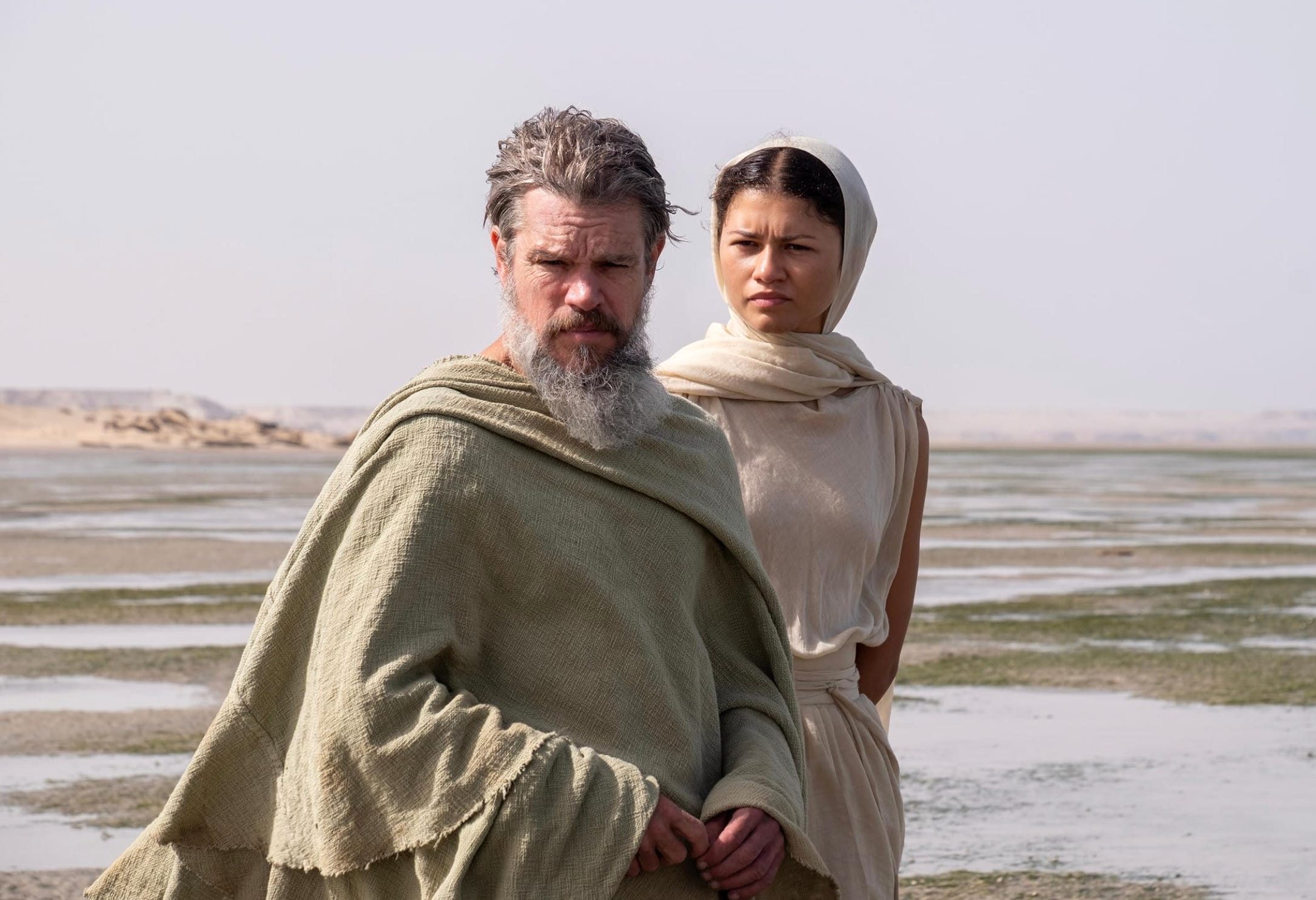
Before you see any of the stellar visuals of The Odyssey, you read the words: “In a time of apparent magic.” From the beginning, Nolan attempts to move viewers beyond themselves and into the narrative.
This story will not make sense from a secular, progressive framework. You have to give yourself to the existence of the supernatural. Hero of the Trojan War, Odysseus may try to defy the gods, but as the film’s audience, we cannot deny the gods.
Though they are not visible, they are present. Everyone, except Odysseus who occasionally interacts with Athena, must accept them solely on faith. But even he is forced to take his own leap of faith in his long journey home.
If you are coming to Nolan’s Odyssey for a strict retelling of Homer’s Odyssey, you will be disappointed.2 Constructing an almost three hour movie, the modern filmmaker includes many classic scenes from the poem, but much is left out by shortening some adventures, combining other moments, and ignoring still more completely.
But Nolan, who never met a story he wants to tell in a straightforward linear fashion, relishes Homer’s unusual structure. The film cuts between three timelines: Telemachus and Penelope fending off the suitors on Ithaca, Odysseus on Calypso’s island, and his recollection of the events of the Trojan War and subsequent attempt to return home.
Like in Homer, much of the film’s action occurs in Odysseus’ retelling of his exploits both at Troy and along islands across the Mediterranean. The cyclops and the witch Circe allowed Nolan to bring more horror elements to his filmmaking.3 Those scenes also demonstrate Odysseus’ pride, which becomes his undoing.
His men and eventually Odysseus himself come to understand the gods are against them. They are being kept from home, and it is precisely because they have challenged and undermined divine commands.
Odysseus must stop fighting and surrender himself to the gods. They will not be mocked. We only understand this fully at the film’s climax.
Hero of the Trojan War, Odysseus may try to defy the gods, but as the film’s audience, we cannot deny the gods.
When Odysseus returns, he is a changed man arriving to a changed place.4 None of his men survive the journey home. He walked to the literal doorstep of hell to escape only to be confronted with his lies.
In Ithaca and around the Greek cities, rumors spread of a sea people, who are invading lands, looting villages, and violating all that the gods command. Much of the anxiety in Odysseus’ homeland comes from the fears stoked by these unknown assailants.
In reality, Odysseus and his men were the “sea people.” By exploiting the Trojan’s trust, their welcoming in a statue to honor the gods, Odysseus has brought an end not only to Troy but all of civilization. No one can practice the hospitality of Zeus any longer because they fear being tricked.
Homer’s poem may have some small echoes of regrets. The Odyssey certainly has a more skeptical view of war than does The Iliad. But Nolan’s version reverberates with Odysseus’ regret. The Trojan Horse becomes like Oppenheimer’s atomic bomb. The hero is praised for his achievement but haunted by its results.
In doing this, the film most removes itself from the classic Greek perspective and causes us to look at the hero’s actions through a modern perspective, one that has been shaped by Scripture. In Nolan’s Odyssey, Christian morality holds sway over Greek mythology.5
Through a stellar action scene, Odysseus does reclaim his wife and home in the film, but only after he confesses his mistakes and looks into the weeping face of Athena.
In the poem, Athena comes down, in all her glory, to stop the cycle of violence after Odysseus kills all of his wife’s suitors. In the movie, however, the Athena Odysseus sees is not all all-powerful goddess arrayed in golden splendor. Instead, she bears the face of a young priestess slaughtered at Troy.
She died because of his sins. But yet, victory was won through the god who was slain and returns to offer hope and new life.
Describing his conversion, C.S. Lewis wrote:
Now the story of Christ is simply a true myth: a myth working on us in the same way as the others, but with this tremendous difference that it really happened: and one must be content to accept it in the same way, remembering that it is God’s myth where the others are men’s myths: i.e. the Pagan stories are God expressing Himself through the minds of poets, using such images as He found there, while Christianity is God expressing Himself through what we call “real things.”
Not being Christopher Nolan, I don’t know his intentions in making The Odyssey, but I agree with Lewis. God worked through ancient myth makers to prepare people’s hearts for Christ. I believe he works through modern myth makers in much the same way.
The Odyssey, be it the ancient poem or the modern film, is God providing glimpses of Himself. Let him who has eyes see.
Miscellaneous thoughts
While watching the movie, I couldn’t help but think of Jesus’ parable of the vineyard owner in Matthew 12. The ungrateful tenant farmers kill the servants and eventually the son of the vineyard owner before he returns to set things right.
Other parallels between Odysseus and Jesus come from both being a king who has been gone to the point that some mock and dismiss his eventual return. But at his inevitable return, he will bring justice for faithful servants and judgment for the wicked.
Odysseus lays himself with outstretched arms on boards of wood and surrenders himself to take the wrath of the gods. He undergoes a type of death before rescuing his people.Critics bent on controversy castigated the movie for months prior to its release, not only divorced of context but absent of seeing the film at all. In doing so, they inadvertently proved one of the film’s thesis correct.
Dishonesty and deceit, even for ostensibly good aims, will undermine those good aims. And, if left unchecked, bring about the ruin of civilization.Much has been made of the casting, most of it by people who had not seen the movie. The actors who dominant the screen time carry the film and deliver Oscar-worth performances, especially Matt Damon and Anne Hathaway.
Only one actress in a fairly minor role (Mia Goth as one of Penelope’s maidservants) threw me out of the film for a second because I wasn’t prepared for her to show up in the movie.
Unless a particular ethnicity is central to a character, I’m not going to get upset over choosing to cast someone of a different racial background. But neither will I lose sleep over a predominantly white cast when that suits the story.
Obviously, these decisions are across a spectrum. Some don’t change anything about the character or the story, but some fundamentally reshape everything. Since it depends on the context, I will always try to reserve my judgments until seeing the character in the role. With The Odyssey, I never had an issue.Ostensibly conservative commentators, mostly on Twitter, have harped on Ellen “Elliot” Page’s role in the film. Rumors were that she was portraying Achilles. Instead, she plays Sinon, in a role that seems deeply ironic.
Sinon is a young boy sent into the Trojan War because cowardly Antinous (Robert Pattinson) manipulates him to take his place in the draft. Sinon dies at Troy because Odysseus lies to him.
Again, I have no idea Nolan’s intentions, but casting Page as a character who is exploited by those stronger than him and lied to by those that should protect him seems like cultural commentary those criticizing Nolan as “woke” would appreciate.
I apologize for any typos. I’d love to have several more hours to think about the movie and edit this review, but I’m finishing this at 1:30 a.m. and I need to get at least a little sleep.
I will let others speak to any idea of “historical faithfulness” involved in a fictional tale. I’m also not an expert on Homer, much less in the original Greek, so I can’t comment beyond my own brief experience with the text. I will also leave that to experts in those fields.
Ludwig Göransson’s score is especially superb in these moments. Throughout the movie, it does drive much of the emotion.
The return home not being one of ease, but still requiring more from the exhausted heroes, reminded me of “The Scouring of the Shire” in The Lord of the Rings. Though, I suppose it might be that Tolkien’s story has drawn from Homer.
In the poem, Odysseus sleeps with numerous women during his voyage home, despite saying his heart is true to his wife. In the movie, several of those are removed and the one that’s not comes from his being deceived himself. The morality in ancient Greece had no issue with the hero sleeping with women on every island in the Mediterranean, while the wife was required to be faithful at home. Christian morality called for everyone, not just women, to be chaste. Nolan’s version reflects that Christian ideal more than the original Greek perspective.