

Lewis and Tolkien on ‘The Odyssey’
What would the two authors think about adapting Homer?

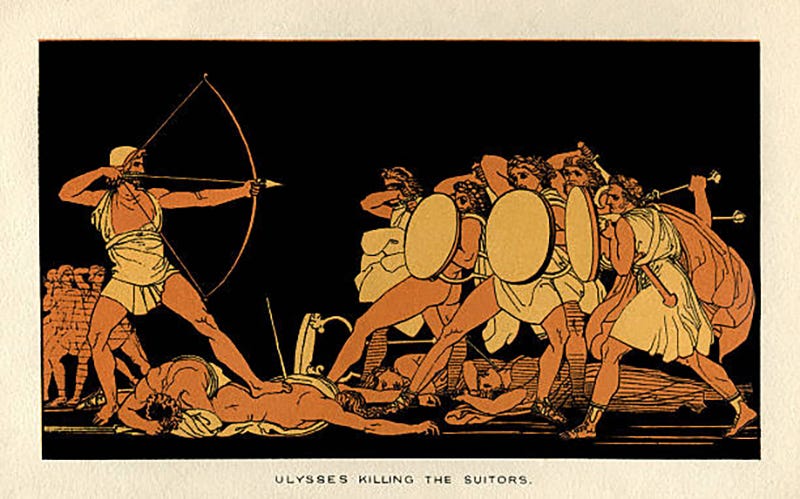
After all of the controversy surrounding the film, Christopher Nolan’s adaptation of The Odyssey is finally in theaters this week. I hope to write my own review and reflections after seeing the film.
Part of the reason for the controversy, besides online provocateurs needing something to fight about, is the foundational place Homer and The Odyssey have in Western Civilization. They are discussed because they are important.
J.R.R. Tolkien and C.S. Lewis certainly knew and appreciated Homer’s epic. Both would’ve been required to translate portions of Homer during their Oxford exams. One visitor to an Inklings meeting described the back-and-forth conversation: “Latin tags flying around. Homer quoted in the original to make a point.”
Lewis said the similarities between his own work and Tolkien’s were due to a similar temperament and common sources. “We are both soaked in Norse mythology, George MacDonald’s fairy tales, Homer, Beowulf, and medieval romance. Also, of course, we are both Christians.”
We can’t be sure what they’d think about a modern cinematic adaptation of the work, but, judging by other comments, we could take a guess.
Lewis: Listening to the Music of Homer
During his early tutoring, he developed a deep love for Homer’s Iliad and The Odyssey in the original Greek. Speaking of The Odyssey in Surprised by Joy, Lewis wrote that “the music of the thing and the clear brightness that lives in almost every formula had become part of me.”
But it wasn’t just a youthful joy for Lewis, Homer came to mind when Lewis looked on the horrors of World War I. In Surprised by Joy, he wrote about the devastation he witnessed and the feeling he had when he heard the first bullet. “This is War. This is what Homer wrote about.”
The Odyssey and Homer remained with Lewis through his academic career and writing. His academic work, A Preface to Paradise Lost, often draws on The Odyssey as an example of an epic poem.
In his early notes for The Voyage of the Dawn Treader, he compared the journey to various islands to Homer’s. He said the White Witch in The Lion, the Witch and the Wardrobe is connected to Circe from The Odyssey as they are the archetype.
Lewis spent his life reading The Odyssey. Friends would often come to his house and read the work together. He knew the book word-for-word.
Once, Lewis bet a fellow Oxford professor that one particular Greek word was not in the text. Later in the records, the other professor records that he paid off the bet with a bottle of port. Lewis was, of course, right.
A few years after his conversion to Christianity, Lewis explained why he initially distrusted his contemporary T.S. Eliot. One of his primary reasons: the famous poet never praised Homer.
He described the epic poem as “part of our common heritage.” When he wanted to particularly praise a book, Lewis compared it to The Lord of the Rings and The Odyssey, works he repeatedly reread.
Perhaps, his review of Robert Fitzgerald’s translation gives an indication of how he would regard a movie adaptation. He frequently criticizes the work for not fully capturing Homer, but he sums up his review by saying:
On the whole, this version has much to commend it. As a substitute for Homer, tolerable—and what substitute was ever more than that? As a book to send the old back to Homer and goad the young on to Homer, it is very well worth while.
Tolkien: Homeric heroes
For the author of The Lord of the Rings, what would spark his love for reading? The epic poems of Homer. “I was brought up in the Classics,” he wrote in a 1953 letter, “and first discovered the sensation of literary pleasure in Homer.”
In 1954, he wrote how he drew on works “like Homer, or Beowulf, or Virgil, or Greek or Shakespearean tragedy” for his own writing. In his letters, Tolkien uses “Homeric” to describe the good men of Middle-earth during the time frame detailed in The Lord of the Rings.
Because of his immense appreciation of the original, Tolkien would probably hate any film adaptations, but he did actually talk once about the possibility of an Odyssey movie and bringing Middle-earth to the big screen.
In an interview with The Telegraph in 1968, he said a teenage girl had written to beg him not to allow The Lord of the Rings to be adapted into a movie. “It would be like putting Disneyland into the Grand Canyon,” she said.
In 1957, Tolkien said he was open to the idea of an animated Lord of the Rings adaptation “with all the risk of vulgarization.” But that next year, he confronted what he considered a disastrous attempt at adapting his story.
In 1958, Tolkien responded to the script of a proposed Lord of the Rings film by Morton Zimmerman. He wrote several pages of criticisms on the first two parts of the movie. When he arrived at the final section, he said it was “totally unacceptable to me, as a whole and in detail.” He concluded the letter by saying, “The Lord of the Rings cannot be garbled like that.”
Probably with that experience in mind, Tolkien told The Telegraph, “It would be easier to film The Odyssey [than The Lord of the Rings]. Much less happens in it. Only a few storms.”
If Peter Jackson can make Tolkien’s trilogy a modern cinematic masterpiece, despite Tolkien’s own likely displeasure, maybe Nolan can successfully adapt the Greek epic with a “few storms.”
Sources:
Surprised by Joy: The Shape of My Early Life — C.S. Lewis
“Odysseus Sails Again” reprinted in Image and Imagination — C.S. Lewis
Becoming C.S. Lewis: A Biography of Young Jack Lewis — Harry Lee Poe
The Making of C.S. Lewis: From Atheist to Apologist (1918-1945) — Harry Lee Poe
C.S. Lewis: The Companion and Guide — Walter Hooper
The Fellowship: The Literary Lives of the Inklings — Philip and Carol Zaleski
The Letters of J.R.R. Tolkien — ed. Humphrey Carpenter
JRR Tolkien interview: ‘It would be easier to film The Odyssey than The Lord of the Rings’ — The Telegraph, March 22, 1968
More from The Wardrobe Door
Archive


Recent


Elsewhere
Men and Women Have Unique Discipleship Strengths, Weaknesses — Lifeway Research
An Impossible Rescue: The sermon I recently preached at my church